
When network traffic grows faster than expected, capacity expansion becomes unavoidable. At this critical moment, engineers and decision-makers often face the same question: DWDM vs New Fiber, which path delivers better long-term value?
Although both approaches can solve bandwidth shortages, their implications differ significantly. Therefore, understanding their real differences is essential before making an investment decision.

Understanding the Capacity Expansion Challenge
As data demand continues to surge, fiber networks are under increasing pressure. However, budgets and construction timelines remain limited. Consequently, network expansion is no longer about choosing the most expensive solution, but rather the most efficient one.
In many cases, capacity exhaustion is not caused by the fiber itself. Instead, it often results from underutilized spectral resources. Thus, evaluating existing infrastructure becomes the first logical step in the DWDM vs New Fiber discussion.
DWDM vs New Fiber: Capacity Potential Compared
Modern DWDM technology has evolved rapidly. Today, a single wavelength can support 100G, 400G, or even 800G transmission rates. Moreover, more than 80 to 120 wavelengths can be multiplexed on one fiber pair.
As a result, DWDM enables operators to unlock enormous hidden capacity without laying new cables. In contrast, new fiber deployment increases capacity by physical expansion, which is effective but far more resource-intensive. Therefore, from a capacity perspective, DWDM vs New Fiber often favors DWDM in the short to medium term.
Cost Efficiency: Why DWDM Often Wins
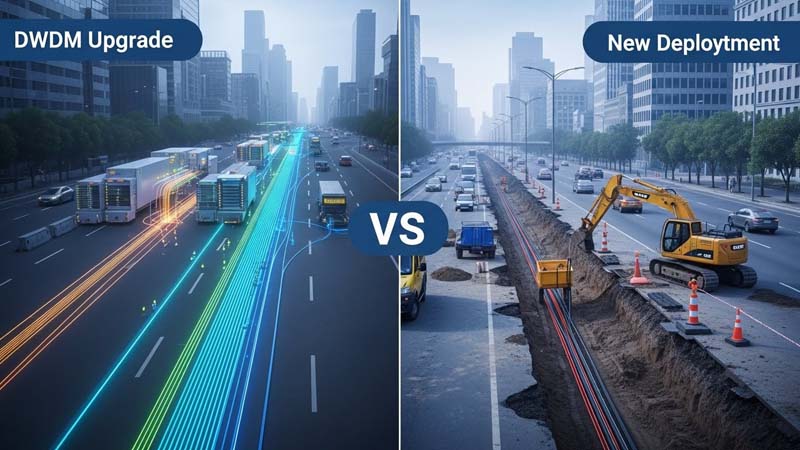
From a financial standpoint, DWDM upgrades require relatively low CAPEX and OPEX. Equipment installation is fast, and existing infrastructure remains in use. Consequently, service expansion can happen with minimal disruption.
On the other hand, new fiber construction involves trenching, permits, labor, and long approval cycles. These factors significantly increase costs and delay deployment. For this reason, when comparing DWDM vs New Fiber, DWDM usually delivers faster returns on investment.
Technical Limits: When New Fiber Becomes Necessary
However, DWDM is not unlimited. As spectral resources approach exhaustion, or when OSNR degrades due to nonlinear effects, further upgrades become less effective. At this stage, physical fiber constraints set hard boundaries.
In such scenarios, new fiber deployment transitions from an optional strategy to a necessary one. Thus, in the long run, DWDM vs New Fiber is not an absolute choice, but a phased decision based on network lifecycle.
DWDM vs New Fiber: Strategic Decision Framework
In most real-world networks, DWDM expansion should be the first choice. It resembles adding lanes to an existing highway rather than rebuilding the road entirely. Nevertheless, when the “roadbed” can no longer sustain future traffic, new fiber construction becomes unavoidable.
Therefore, a balanced decision should consider three factors: projected business growth, financial tolerance, and technical longevity. By evaluating these dimensions together, organizations can make smarter choices in the DWDM vs New Fiber debate.
Final Thoughts
Ultimately, DWDM vs New Fiber is not about technology alone. It is about aligning network evolution with business reality. For many CFOs, the words “excavation and construction” remain sensitive. As a result, maximizing existing fiber through DWDM often represents the most rational and scalable path forward—until the limits are truly reached.