
800G ZR Pluggable Module technology is rapidly reshaping the future of optical transport networks. As global data traffic continues to grow at an unprecedented pace, operators face increasing pressure to deliver higher bandwidth while controlling power consumption, footprint, and long-term cost. Consequently, traditional CWDM solutions are struggling to keep up with modern network demands.

In contrast, the 800G ZR Pluggable Module offers a new balance of performance, efficiency, and scalability. By combining coherent optics with a standardized pluggable form factor, it enables network architects to build simpler, denser, and more energy-efficient infrastructures.
From CWDM to Coherent Pluggables: Why Networks Must Evolve
For many years, CWDM served as a practical solution for short- and medium-reach transmission. It offered straightforward deployment and relatively low initial costs. However, as bandwidth requirements moved from tens of gigabits to hundreds of gigabits per link, CWDM architectures began to reveal structural limitations.
More importantly, CWDM relies on parallel optical channels to scale capacity. As a result, operators must deploy more modules, more ports, and more fibers. Therefore, power consumption and rack space usage increase rapidly. In large-scale data centers and metro networks, this approach becomes inefficient and difficult to sustain.
Meanwhile, coherent pluggable optics have matured significantly. As DSP performance improved and component integration advanced, coherent technology moved into compact, standardized modules. This shift set the stage for the 800G ZR Pluggable Module to emerge as a practical and scalable alternative.
Technical Foundation of the 800G ZR Pluggable Module
At a technical level, the 800G ZR Pluggable Module uses advanced coherent modulation and high-performance digital signal processing. Together, these technologies allow a single module to carry massive bandwidth over existing fiber infrastructure.
Unlike traditional solutions, coherent transmission compensates for fiber impairments electronically. Therefore, it achieves higher spectral efficiency and longer reach without complex optical designs. In addition, the pluggable form factor enables direct integration into switches and routers. This integration reduces reliance on dedicated transport platforms.
As a result, the 800G ZR Pluggable Module transforms how networks are built. It shifts capacity closer to IP layers and simplifies overall architecture.
Cost per Gbps Reaches a Critical Inflection Point
When evaluating optical technologies, cost per Gbps is often more important than module price alone. This metric reflects the true economic efficiency of a solution. According to industry forecasts, by Q4 2025 the cost per Gbps of the 800G ZR Pluggable Module is expected to drop below USD 12.
This milestone is significant. Once coherent pluggable modules achieve lower unit bandwidth cost than CWDM, the economic advantage becomes clear. Higher capacity per port means fewer modules, fewer interfaces, and less fiber consumption. Consequently, operators can reduce both capital expenditure and operational complexity.
Moreover, lower cost per bit accelerates adoption across data center interconnection and metro networks. As deployment volumes increase, economies of scale further reinforce this trend.
Lower Power Consumption Drives Sustainable Network Design
Power efficiency has become a defining factor in network planning. Data centers face strict energy budgets, while operators must also consider sustainability goals. In this context, the 800G ZR Pluggable Module delivers a clear advantage.
Because it concentrates far more bandwidth into a single module, it reduces the number of active components required to achieve a given capacity. Therefore, power consumption per transmitted bit continues to decline. In comparison, CWDM architectures require many parallel optics, which increases total system power.
In addition, fewer modules simplify cooling and power distribution. Over time, these operational savings become substantial, especially in large-scale deployments.

Higher Density Enables Simpler and Scalable Architectures
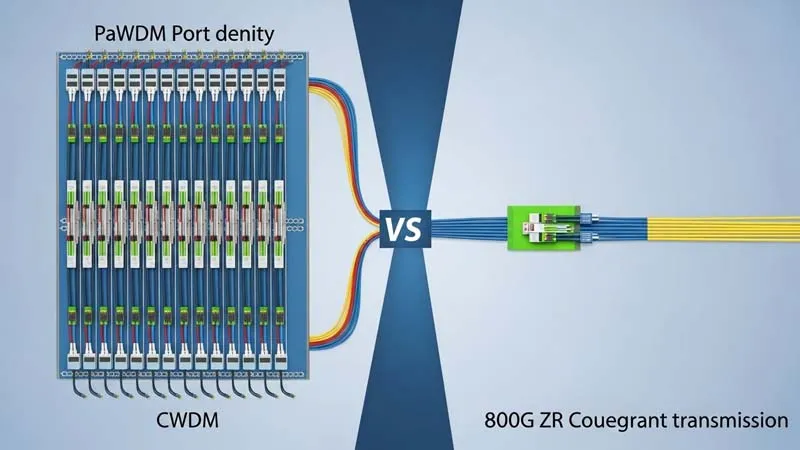
Port density directly affects how efficiently a network scales. The 800G ZR Pluggable Module allows operators to increase capacity without expanding physical footprint. As a result, switches and routers can deliver terabit-scale throughput using fewer slots.
By contrast, CWDM solutions often encounter port exhaustion as traffic grows. Adding capacity requires additional hardware and complex cabling. Therefore, network expansion becomes slower and more expensive.
With coherent pluggables, networks adopt a flatter and more modular design. This approach not only simplifies current deployments but also prepares infrastructure for future speeds such as 1.6T.
Key Application Scenarios for the 800G ZR Pluggable Module
In data center interconnection scenarios, the 800G ZR Pluggable Module enables high-capacity links between facilities with minimal equipment. Consequently, operators can maximize fiber utilization and reduce inter-site complexity.
Similarly, in metro and aggregation networks, high-density coherent pluggables support capacity upgrades without major architectural changes. This flexibility is especially valuable as traffic patterns become more dynamic.
Therefore, the 800G ZR Pluggable Module does not simply replace CWDM. Instead, it delivers a comprehensive upgrade across performance, cost, power efficiency, and scalability.

A Clear Industry Direction
Overall, the industry has moved beyond evaluating whether coherent pluggables are viable. Today, the question is how quickly networks can transition. As costs decline and ecosystems mature, adoption of the 800G ZR Pluggable Module will continue to accelerate. Meanwhile, the role of CWDM will narrow to niche scenarios.
In this evolving environment, HTF continues to support global operators with professional optical fiber products and WDM system solutions. With more than ten years of experience in optical communication R&D, fiber solutions, and component manufacturing, HTF provides end-to-end transmission solutions for data centers, 5G networks, cloud platforms, and metro networks.
HTF’s HT6000 OTN optical transmission system offers a compact, high-capacity, and cost-effective platform based on a unified CWDM/DWDM design. It supports node capacities beyond 1.6T and enables flexible networking for IDC and ISP operators. As high-speed coherent technologies advance, HTF remains committed to helping customers build efficient, scalable, and future-ready optical infrastructures.