
Optical Transport Network technology continues to evolve as global data traffic grows rapidly.
As a result, OTN 100G and OTN 400G have become two critical generations in modern transport networks.
Although both standards coexist today, they serve clearly different roles across network layers and traffic demands.
In this context, understanding the differences between OTN 100G and OTN 400G becomes essential for operators and planners.
Therefore, this article provides a structured comparison focused on capacity, modulation, transmission distance, spectrum utilization, components, and deployment strategies.
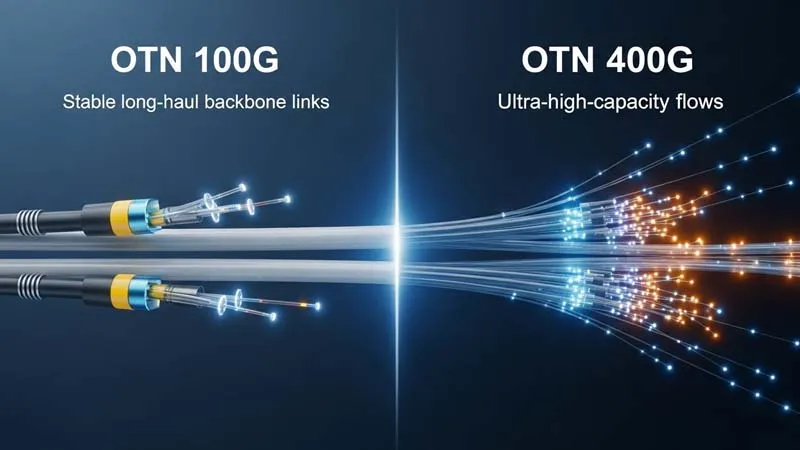
The Evolution from OTN 100G to OTN 400G
Over the past decade, OTN 100G has become the global backbone standard.
In practice, it delivers strong stability, mature operation models, and wide international deployment.
However, traffic patterns are changing rapidly.
Consequently, traditional backbone architectures face growing pressure from cloud computing and large-scale data exchange.
As a result, OTN 400G has emerged to support ultra-large-capacity backbone networks, particularly for east–west traffic and data center interconnection.
Importantly, OTN 100G and OTN 400G are not direct competitors in the short term.
Instead, they coexist and complement each other across different network layers.
Single-Wavelength Rate and Overall Capacity
OTN 100G Capacity Characteristics
OTN 100G delivers a single-wavelength rate of 100 Gbit/s.
Because of its fixed-grid design, a typical C-band system supports around 80 wavelengths, resulting in approximately 8T per fiber.
OTN 400G Capacity Advantages
By contrast, OTN 400G increases the single-wavelength rate to 400 Gbit/s.
As a result, total fiber capacity can scale from 10T to more than 32T, which significantly reduces congestion in high-traffic backbone corridors.
Modulation Technologies and Signal Efficiency
Modulation in OTN 100G
OTN 100G mainly relies on proven modulation formats.
Specifically, DP-QPSK supports long-haul backbone transmission, while DP-16QAM targets metro and access networks.
Therefore, OTN 100G achieves a balanced trade-off between reach and spectral efficiency.
Advanced Modulation in OTN 400G
OTN 400G introduces more advanced schemes.
For example, high-symbol-rate DP-QPSK enables extended reach, while DP-16QAM with Probabilistic Constellation Shaping improves flexibility.
As a result, OTN 100G and OTN 400G differ not only in speed but also in adaptability and intelligence.
Transmission Distance Comparison
Transmission distance remains a key differentiator between OTN 100G and OTN 400G.
In general, OTN 100G can exceed 3000 km using DP-QPSK.
By comparison, OTN 400G typically reaches shorter distances due to higher symbol rates.
However, performance depends on modulation choices.
For instance, 16QAM-PCS supports approximately 720 km, while QPSK-based 400G links can exceed 1500 km on low-loss G.654.E fiber.
Therefore, higher capacity inevitably brings stricter OSNR and fiber requirements.
Spectrum Utilization and Waveband Expansion
Spectrum Use in OTN 100G
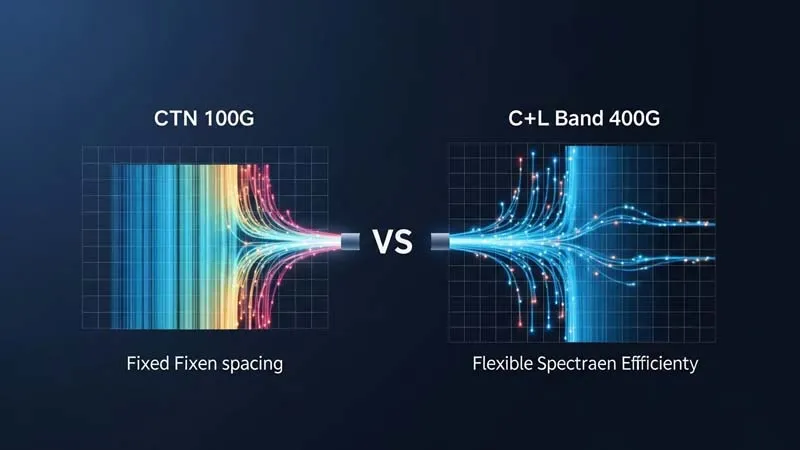
OTN 100G primarily operates in the C-band with fixed 50 GHz spacing.
As a result, spectrum planning remains simple and predictable.
Flexible Spectrum in OTN 400G
OTN 400G expands into the C+L band and supports flexible grid spacing.
Consequently, spectrum efficiency improves significantly.
However, at the same time, power balancing and Raman effects require more advanced engineering solutions.
Component and DSP Requirements
The evolution from OTN 100G and OTN 400G also reflects major changes in hardware design.
OTN 100G typically uses symbol rates around 32 GBaud.
In contrast, OTN 400G increases symbol rates to 90–130 GBaud.
Therefore, 400G systems demand advanced DSP chips, high-speed DAC/ADC modules, and next-generation optoelectronic components.
At the same time, power consumption and thermal design become critical considerations.
Application Scenarios and Cost Efficiency
Where OTN 100G Excels
OTN 100G benefits from long-term deployment experience.
As a result, it offers lower initial investment and proven reliability for long-haul backbone networks.
Where OTN 400G Delivers Value
OTN 400G focuses on capacity-intensive scenarios.
In particular, it targets data center interconnect, metro core networks, and high-traffic backbone routes.
Over time, therefore, its lower cost per bit provides a clear economic advantage.

Operational Complexity and Network Management
OTN 100G benefits from stable operational models.
Consequently, maintenance processes remain relatively straightforward.
OTN 400G introduces flexible modulation and wider wavebands.
As a result, network planning and operation become more complex.
Therefore, intelligent automation, AI-assisted optimization, and digital twin technologies play an increasingly important role.
Choosing Between OTN 100G and OTN 400G
In conclusion, OTN 100G and OTN 400G serve distinct but complementary roles.
OTN 100G remains ideal for cost-effective, large-scale deployment.
Meanwhile, OTN 400G defines the future of ultra-high-capacity optical transport.
Rather than replacing 100G immediately, 400G will first dominate backbone core layers.
Ultimately, OTN 100G and OTN 400G will coexist and jointly form the all-optical foundation for the computing power era.