
Short- and Medium-Reach DWDM has become a critical foundation for modern metro network evolution. As digital infrastructure expands, traffic growth no longer concentrates only in backbone cores. Instead, it increasingly emerges at metro edges, access layers, and aggregation nodes. Therefore, operators and enterprises now seek transmission solutions that deliver high capacity, cost efficiency, and deployment flexibility over short and medium distances.
In this context, Short- and Medium-Reach DWDM offers a practical and scalable response. By balancing performance with economics, it enables metro networks to support 5G transport, enterprise private lines, and edge computing with long-term sustainability.
The Shift from Core-Oriented Networks to Edge-Driven Architectures
Traditionally, metro networks evolved around core nodes. At that time, network planning prioritized long-distance transmission and ultra-high capacity. However, traffic behavior has changed significantly. Today, data increasingly originates and terminates closer to users.
On one hand, 5G deployment continues to accelerate. As a result, dense base station layouts generate massive fronthaul, midhaul, and backhaul traffic within metro areas. On the other hand, enterprise private networks are expanding rapidly. These networks demand guaranteed bandwidth, stability, and fast provisioning.
Moreover, edge computing pushes data processing closer to access points. Consequently, east–west traffic within metro networks grows steadily. Under these conditions, access and aggregation layers become the most critical segments of the network.
Therefore, Short- and Medium-Reach DWDM emerges as a natural solution for this structural shift.
Why Metro Networks Demand Short- and Medium-Reach DWDM
Metro network challenges differ greatly from backbone scenarios. While capacity remains essential, cost control and operational simplicity are equally important.
First, traditional point-to-point optical links consume excessive fiber. As networks scale, fiber scarcity becomes a serious constraint. Second, long-haul DWDM systems often exceed metro requirements. Although powerful, they introduce unnecessary complexity and higher total cost of ownership.
In contrast, Short- and Medium-Reach DWDM directly targets metro distances, typically ranging from 10 km to 80 km. As a result, it delivers sufficient capacity without overengineering the network.
Key Metro Application Scenarios Driving DWDM Adoption
5G Transport Networks
5G networks impose strict requirements on bandwidth, latency, and synchronization. Therefore, metro transport must scale efficiently. By using wavelength multiplexing, Short- and Medium-Reach DWDM allows multiple high-speed services to share limited fiber resources. Consequently, operators can expand capacity while controlling cost.
Enterprise and Industry Private Lines
Industries such as finance, government, energy, and transportation rely on dedicated connections. These customers require reliability, isolation, and flexible bandwidth upgrades. In this case, Short- and Medium-Reach DWDM enables multiple enterprise services to coexist on the same fiber while maintaining strong service separation.
Edge Computing and Local Data Processing
Edge computing increases localized traffic flows. As a result, metro networks must handle more east–west traffic over short distances. Short- and Medium-Reach DWDM supports this trend by offering high capacity and fast deployment at the edge.
Technical Advantages of Short- and Medium-Reach DWDM
From a technical perspective, Short- and Medium-Reach DWDM focuses on efficiency and simplicity.
First, it uses compact platforms and highly integrated optical modules. Therefore, system footprint and power consumption remain low. Second, it supports mainstream line rates such as 100G and 400G. As traffic grows, operators can scale capacity smoothly.
In addition, flexible combinations of coherent and non-coherent technologies allow precise cost-performance optimization. Consequently, networks avoid unnecessary expenditure while maintaining future readiness.
Most importantly, Short- and Medium-Reach DWDM significantly improves fiber utilization. In metro environments, this advantage directly translates into long-term investment protection.

Reshaping Metro Access and Aggregation Architectures
As adoption expands, Short- and Medium-Reach DWDM reshapes how metro networks are designed.
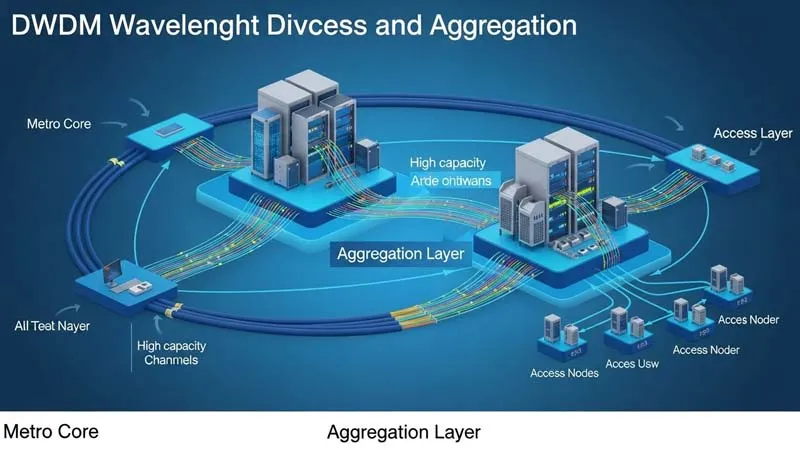
Instead of multi-layer aggregation, networks evolve toward flatter architectures. Access nodes can connect directly to aggregation layers using DWDM. As a result, service provisioning becomes faster and more flexible.
Moreover, capacity expansion no longer requires major fiber construction. Operators simply add wavelengths or upgrade line rates. Therefore, network evolution becomes predictable and cost-effective.
Over time, Short- and Medium-Reach DWDM becomes a foundational capability rather than a specialized solution.
Industry Evolution and Deployment Trends
Looking ahead, Short- and Medium-Reach DWDM continues to evolve in several directions. Higher integration reduces hardware complexity. Lower power consumption supports green network goals. Meanwhile, deeper integration with OTN and IPoDWDM enhances service flexibility.
At the same time, solution providers with strong system-level expertise play a decisive role. HTF is a professional supplier of fiber products and WDM system solutions. Backed by a team with over ten years of experience in optical communication R&D, fiber solutions, and component manufacturing, HTF supports global data centers, 5G networks, cloud computing, metro networks, and access networks.
HTF’s HT6000 compact OTN optical transmission system adopts a CWDM/DWDM universal platform design. Therefore, it supports transparent multi-service transmission and flexible networking. With high capacity and cost-effective architecture, it meets the needs of national backbone, metro backbone, and core networks. Moreover, it provides IDC and ISP operators with scalable WDM expansion beyond 1.6T per node.
A Practical Path to Sustainable Metro Networks
In summary, Short- and Medium-Reach DWDM is redefining metro network construction in a pragmatic and sustainable way. It addresses bandwidth growth, fiber scarcity, and cost efficiency at access and aggregation layers. At the same time, it prepares networks for future services driven by 5G, cloud, and edge computing.
As digital infrastructure continues to evolve, Short- and Medium-Reach DWDM stands out as an indispensable building block for modern metro networks, enabling long-term performance, scalability, and investment protection.