
A ROADM Network enables fully optical, software-driven wavelength provisioning in DWDM systems.
Unlike traditional fixed architectures, network operators can add, drop, or reroute wavelengths remotely. Therefore, teams no longer need to redesign the physical network.
As bandwidth demand continues to grow, optical networks have expanded from 8–16 wavelengths to 48–96 wavelengths per fiber. However, this expansion also increases operational complexity. As a result, operators now rely on ROADM Network technology to simplify modern WDM and OTN deployments.
Why it Is Critical for 400G WDM/OTN Systems
With the adoption of 400G WDM/OTN, networks must handle higher capacity while maintaining flexibility and reliability.
A ROADM Network directly supports this transition.
First, it enables dynamic wavelength routing, which significantly shortens service deployment time.
Moreover, operators can modify wavelength paths without interrupting existing services.
Therefore, networks achieve better scalability while reducing operational expenditure.
In addition, ROADM Network architectures simplify wavelength tracking and monitoring across complex optical infrastructures.
Core Functional Advantages of a ROADM Network
Dynamic Wavelength Provisioning
A ROADM Network allows operators to route any wavelength toward any direction or node port.
As a result, teams can activate, modify, or remove services in real time.
Automatic Optical Power Balancing
Dense DWDM systems often face optical power imbalance risks.
However, a ROADM Network actively balances wavelength power levels across the network.
This capability becomes especially critical in links that include multiple EDFAs and high channel counts.
Without proper balancing, some wavelengths experience performance degradation. Therefore, it power control improves transmission quality and ensures service stability.
Key Components of a ROADM Network
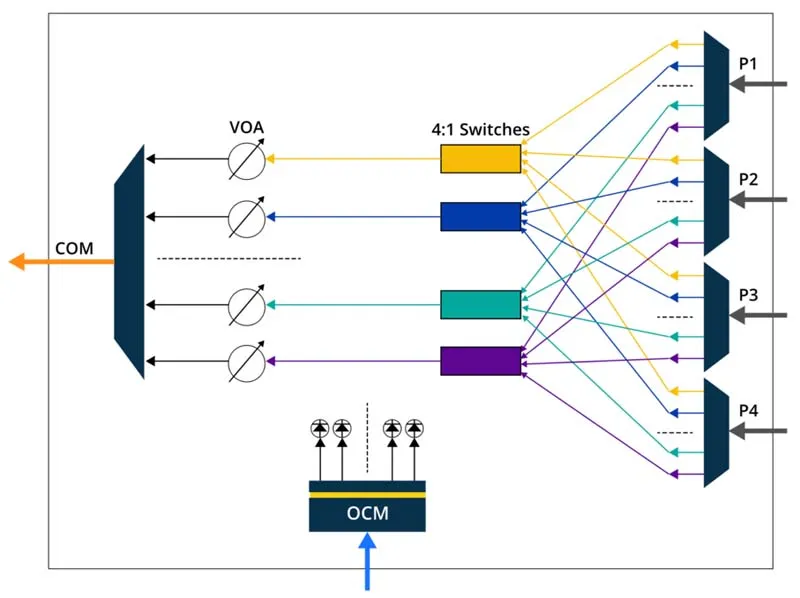
A standard it includes several essential optical components.
Wavelength Selective Switch (WSS)
The WSS performs the core switching function within a ROADM Network.
It actively routes any wavelength to or from any port. Moreover, software control allows operators to change connectivity instantly.
Optical Channel Monitor (OCM)
The OCM tracks the optical power of each wavelength in real time.
As a result, operators maintain full visibility into channel performance.
Variable Optical Attenuators (VOAs)
VOAs dynamically adjust optical power on a per-wavelength basis.
Together with the OCM, they maintain precise power balance across the entire it.
These components work together to protect signal quality and ensure stable network operation.
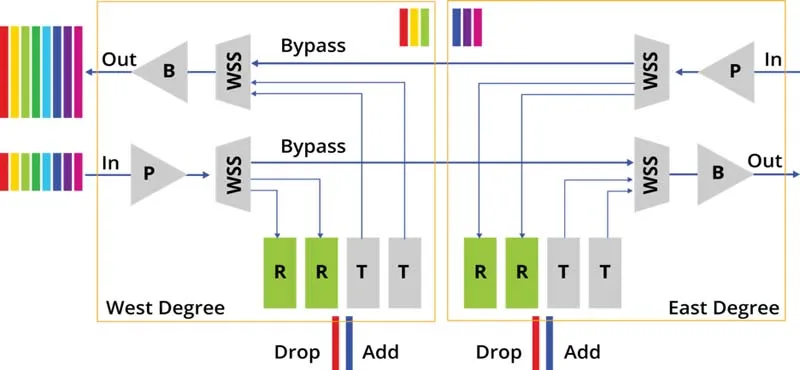
ROADM Network Node Architecture
A ROADM node consists of multiple ROADM devices interconnected through their input ports.
Each device represents a switching direction, commonly known as a degree.
The number of degrees defines how many fiber directions a node supports. Therefore, designers can adapt it architecture to different network topologies.
It in Ring Topologies
Ring networks typically deploy two-degree ROADM nodes.
Each node includes east-facing and west-facing ROADM devices.
In this architecture, the WSS can:
- Drop selected wavelengths locally
- Bypass wavelengths to the next node
- Block unwanted channels when necessary
Moreover, when operators combine tunable transceivers with ROADM nodes, the ROADM Network becomes highly flexible and easy to scale.
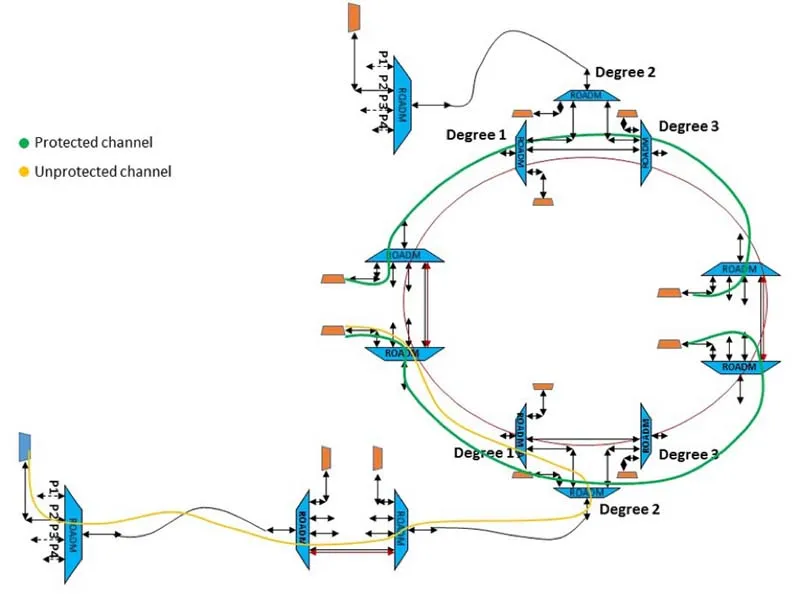
If a service failure occurs, protection wavelengths automatically reroute around the fault. As a result, the network maintains high resilience.
It in Mesh Architectures
Two-degree nodes suit simple ring topologies. However, mesh networks require higher-degree ROADM nodes.
Engineers build these nodes by interconnecting multiple WSS modules.
For example, a three-degree it node connects three different fiber directions.
Therefore, the network can route wavelengths from any line to any other line or add/drop port.
This multi-degree capability enables advanced traffic engineering and fast service restoration in complex optical networks.
Conclusion: it as the Foundation of 400G WDM/OTN
In summary, a ROADM Network serves as a foundational technology for modern 400G WDM/OTN transport systems.
It delivers flexibility, scalability, and operational efficiency across both ring and mesh architectures.
By enabling dynamic wavelength routing, precise power control, and rapid service recovery, ROADM Network solutions help operators meet growing bandwidth demands with confidence.
As optical networks continue to evolve, it technology will remain a core pillar of intelligent, software-defined optical infrastructure.