
The rapid expansion of artificial intelligence, especially Large Language Model (LLM) training, is driving an unprecedented surge in data transmission and storage demands. As a result, metro networks are under growing pressure to scale bandwidth quickly, efficiently, and cost-effectively. In this context, DWDM and CWDM have become essential technologies for operators seeking sustainable capacity growth without excessive fiber deployment.
Rather than treating these two technologies as competing solutions, modern networks increasingly rely on DWDM and CWDM working together. This hybrid approach unlocks massive performance gains while protecting existing investments.
The Capacity Challenge Facing Metro Networks
Today’s AI workloads generate enormous east-west traffic within data centers and between metro nodes. Consequently, traditional single-wavelength or low-density optical solutions struggle to keep pace. Although laying new fiber remains an option, it is expensive, slow, and often impractical in urban environments.
Therefore, increasing capacity per fiber has become the most realistic path forward. This is precisely where DWDM and CWDM demonstrate their strategic value.
Understanding CWDM Limitations in High-Growth Scenarios
CWDM is widely deployed in access and metro networks due to its simplicity and cost efficiency. Typically, CWDM supports up to 18 wavelengths, ranging from 1271 nm to 1611 nm, with 20 nm spacing between channels.
However, this wide spacing introduces clear limitations:
- The number of available channels is inherently restricted
- Spectral efficiency remains relatively low
- Scaling beyond initial capacity is difficult
As traffic demand accelerates, CWDM alone can no longer meet long-term growth requirements. At this stage, operators must look beyond standalone CWDM solutions.
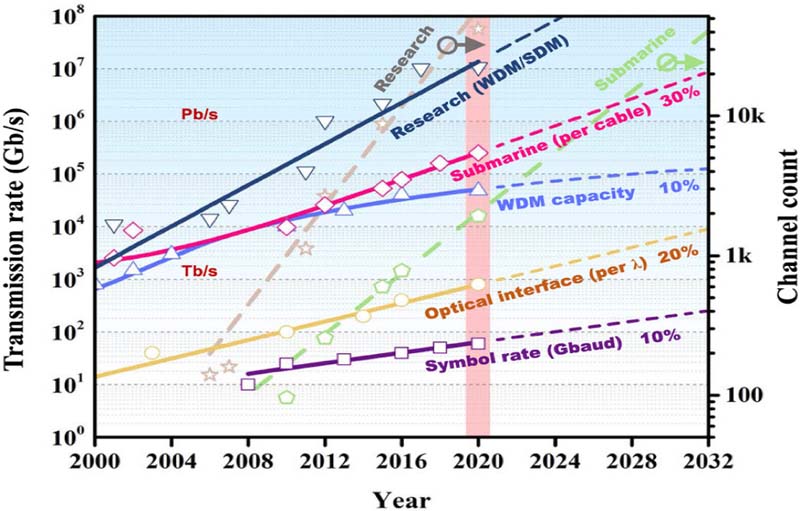
DWDM Breakthrough: Unlocking Dense Spectral Capacity
In contrast, DWDM dramatically increases fiber utilization by placing wavelengths much closer together. Within the C-band (approximately 1530–1565 nm), DWDM systems can support:
- 40 channels at 100 GHz spacing (≈0.8 nm)
- 80 or more channels at 50 GHz spacing
As a result, DWDM and CWDM differ not only in scale but also in strategic purpose. DWDM is designed for high-capacity backbone and metro aggregation, where spectral efficiency is critical.
Moreover, DWDM provides the foundation needed for exponential bandwidth growth.
Increasing Capacity Per Channel: Beyond Wavelength Count
While adding more wavelengths increases total capacity, boosting the data rate per wavelength is equally important. Therefore, modern optical networks focus on both dimensions simultaneously.
This evolution is enabled by advanced optical transceivers such as QSFP28 and QSFP-DD, which support higher data rates through improved modulation techniques.
From NRZ to PAM4: A Key Technology Shift
Traditionally, optical systems relied on NRZ (Non-Return-to-Zero) modulation, which uses two signal levels to encode one bit per symbol. However, PAM4 introduces four distinct signal levels, allowing each symbol to carry two bits.
As a result:
- The data rate doubles
- The baud rate remains unchanged
- Spectral efficiency increases significantly
This shift is central to how DWDM and CWDM networks achieve massive performance gains without proportionally increasing hardware complexity.
Calculating the 10x Capacity Increase
By combining dense wavelength deployment with higher per-channel speeds, operators can achieve dramatic results.
Consider the following scenario:
- A 40-channel DWDM system
- Each channel upgraded from 10G (NRZ) to 100G (PAM4)
This leads to:
- Per-channel increase: 10×
- Total capacity: 40 × 100 Gbps = 4 Tbps
This calculation clearly demonstrates how DWDM and CWDM, when properly integrated, can support exponential traffic growth.
Hybrid Architecture: Where DWDM and CWDM Work Together
The true strength of modern optical networks lies in hybrid architectures. Rather than replacing CWDM outright, operators can deploy DWDM alongside existing CWDM systems.
Coexistence on the Same Fiber
Because CWDM and DWDM often operate in different spectral bands, coexistence is possible:
- CWDM services can continue in bands such as the O-band
- DWDM systems typically occupy the C-band
- Wavelength overlap is avoided
As a result, DWDM and CWDM can run simultaneously on the same fiber, maximizing asset utilization.
Spectrum Expansion Beyond the C-Band
Furthermore, capacity can be extended even further by expanding DWDM operation into the L-band. This adds:
- An additional 40 to 80 channels
- Significant headroom for future growth
Therefore, hybrid architectures not only solve today’s challenges but also prepare networks for long-term scalability.
Investment Protection and Smooth Network Evolution
One of the most compelling advantages of combining DWDM and CWDM is financial efficiency. Instead of forcing immediate equipment replacement, hybrid designs allow for:
- Gradual upgrades aligned with demand
- Preservation of existing CWDM assets
- Optimized capital expenditure planning
Consequently, operators gain both technical and economic flexibility.
DWDM and CWDM as a Unified Strategy
In the era of AI-driven traffic growth, metro networks must deliver more bandwidth without sacrificing stability or investment returns. By integrating DWDM and CWDM, operators achieve:
- Up to 10x capacity improvements
- Higher spectral efficiency
- Seamless evolution paths
- Long-term infrastructure protection
Ultimately, DWDM and CWDM are no longer separate choices. Together, they form a unified, future-proof strategy for modern optical networks.