
Single-Fiber Bidirectional Transmission is rapidly becoming a cornerstone technology for next-generation optical interconnects. As AI clusters continue to expand, the demand for dense and efficient data exchange between cabinets grows sharply. Moreover, electrical links and traditional paired-fiber architectures are reaching their limits. Therefore, Lightmatter’s breakthrough—enabling 16 wavelengths of bidirectional traffic over one standard fiber—signals a decisive shift toward ultra-high-density DWDM networking.

AI training, cloud workloads, and supercomputing continue to push data volume to extraordinary levels. However, paired-fiber deployments introduce cost, space, and maintenance challenges. Consequently, Single-Fiber Bidirectional Transmission has emerged as a compelling path to increase capacity while simplifying infrastructure.
- Growing AI Bandwidth Demands Are Reshaping Optical Interconnects
Modern GPU clusters rely on high-speed communication for model synchronization. As a result, cross-cabinet bandwidth has become a critical performance factor. Large deployments reveal several issues:
- Fiber bundles grow faster than available routing space.
- Cabling complexity increases operational risk.
- Troubleshooting becomes more difficult and time-consuming.
- Power consumption rises due to dense optical modules.
Therefore, the industry urgently needs a new approach that increases bandwidth density without expanding fiber counts. Single-Fiber Bidirectional Transmission provides that opportunity.
- Lightmatter’s Breakthrough: 16 Wavelengths, One Fiber, Full Bidirectionality
Lightmatter’s architecture delivers 16 independent wavelengths through a single fiber in both directions. Moreover, it enhances port efficiency, reduces hardware footprints, and opens the door to deeper optical integration.
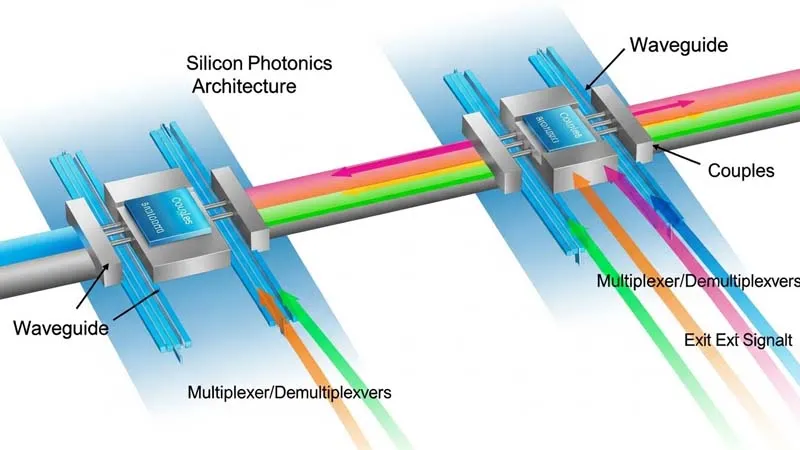
1) A Leap in Fiber Utilization Efficiency
Traditional DWDM requires paired fibers for uplink and downlink channels. However, Lightmatter merges both into a single path. Consequently, one fiber can now deliver twice the effective throughput. This achievement highlights advances in silicon photonics, wavelength isolation, and low-cost coupling efficiency.
2) Why 16-Wavelength Short-Reach DWDM Is Strategically Important
DWDM has long been used for long-haul networks, yet short-reach applications remained limited. Now, with AI infrastructure expanding, multi-wavelength short-distance transport is becoming crucial. Therefore, Lightmatter’s design signals the beginning of DWDM’s migration into data center interiors.
- System-Level Transformation Enabled by Single-Fiber Bidirectional Transmission
1) Dramatic Reduction in Cabling Complexity
Large AI clusters may require hundreds of fibers between racks. However, a multi-wavelength single-fiber approach can reduce fiber usage by up to 90%. As a result, it simplifies routing, improves airflow, reduces risk, and enhances operational efficiency.
2) Lower Cost and Energy Consumption Over Time
Fewer fibers, fewer connectors, and fewer modules translate into a leaner infrastructure. Moreover, silicon photonics will continue to drive down costs. Therefore, this technology aligns perfectly with long-term data center efficiency goals.
3) Enabling Software-Defined Optical Networking
As wavelength density grows, real-time monitoring becomes essential. Consequently, SDN-based optical management will play a larger role. This shift will influence how data centers plan growth, manage wavelengths, and respond to network changes.

- A Paradigm Shift: DWDM Moves From Long-Haul to Inter-Cabinet Use
DWDM was once a technology reserved for long-distance communication. However, data centers now require high spectral efficiency over short distances. Therefore, the shift toward intra-facility DWDM is both natural and inevitable.
1) Why DWDM Matters More Inside Data Centers
AI workloads require dense, scalable bandwidth. Consequently, DWDM’s ability to multiply capacity without adding physical fibers makes it a perfect fit for rack-level interconnects.
2) Future Integration: From Modules to Embedded Optics
With the rise of silicon photonics and co-packaged optics, wavelength management will increasingly move inside switches and compute modules. As a result, future optical systems may look fundamentally different from those of today.
- Challenges Remain, Yet the Direction Is Clear
Although Single-Fiber Bidirectional Transmission holds strong promise, industry adoption will require:
- Long-term reliability validation
- Standardization across vendors
- O&M frameworks suited for multi-wavelength single-fiber paths
- Continuous cost improvements
However, the fundamental trend toward higher density and lower power usage is irreversible.
- Entering a New Optical Interconnect Era
Lightmatter’s technology marks a pivotal milestone. It accelerates DWDM’s transition from long-haul links to short-reach, high-density roles. Moreover, it sets the stage for new architectures built around spectral efficiency, silicon integration, and dense optical fabrics. Consequently, Single-Fiber Bidirectional Transmission will guide the evolution of data center networks.
- HTF’s Contribution to Global Optical Infrastructure
In this evolving landscape, industry partners with deep technical expertise are essential. HTF provides advanced fiber-optic products, WDM solutions, and high-capacity transport systems built by a team with more than ten years of optical development experience. Moreover, HTF supports global data centers, 5G deployments, cloud platforms, metro networks, and access networks through reliable transmission design and service.
The HTF HT6000 OTN platform offers compact, flexible, and cost-efficient DWDM and CWDM capabilities. It supports multi-service transparent transport and scales beyond 1.6T per node, making it ideal for IDC operators and ISPs seeking high-density WDM expansion.
As a result, HTF continues to help organizations build, optimize, and elevate the next generation of optical infrastructure.