
Modern data centers depend heavily on stable optical communication. However, when video conferences freeze or packet loss becomes unpredictable, the issue often traces back to a single overlooked component—the Patch Cord. Although small in size, it directly affects signal quality, network stability, and even long-term system health. Consequently, understanding how Patch Cord issues emerge is essential for maintaining a resilient optical infrastructure.
How Patch Cord Contamination Leads to Direct Physical Signal Loss
Contamination remains the most common and destructive threat to Patch Cord performance. Even small particles or films on the connector end-face reduce optical clarity. As a result, both insertion loss and return loss rise sharply, undermining network reliability.
- Insertion Loss Surge
When contaminants scatter or absorb optical energy, the transmitted signal experiences attenuation. This effect is similar to trying to view the world through a dirty glass window—everything becomes dim and unclear. Even a single dust particle on the 9 µm fiber core may drastically increase loss, pushing a link designed for under 0.3 dB to exceed 1.0 dB. Consequently, the optical power budget is quickly consumed, leading to unstable transmission.
- Return Loss Degradation
Whenever a Patch Cord transitions from clean glass to an air gap or contaminant layer, Fresnel reflections occur. This phenomenon resembles how sound echoes back off a hard surface. While a properly polished APC connector achieves −65 dB of return loss, contamination may degrade that level to −20 dB or worse. Therefore, the reflected light disrupts laser stability, introduces waveform distortion, and increases overall link sensitivity to noise.
Cascading Network Effects Triggered by Patch Cord Failures
Although contamination may begin at the physical layer, its consequences quickly propagate through upper network layers. These issues often appear as intermittent “soft failures,” which are notoriously challenging to diagnose.
Increased Bit Error Rate and Packet Loss
When optical power falls below the receiver’s threshold, or when waveform distortion increases, the receiver struggles to differentiate between “1” and “0.” As a result, bit errors rise, and packet integrity is compromised. Ultimately, this leads to lag, dropped sessions, and degraded quality during high-bandwidth activities.
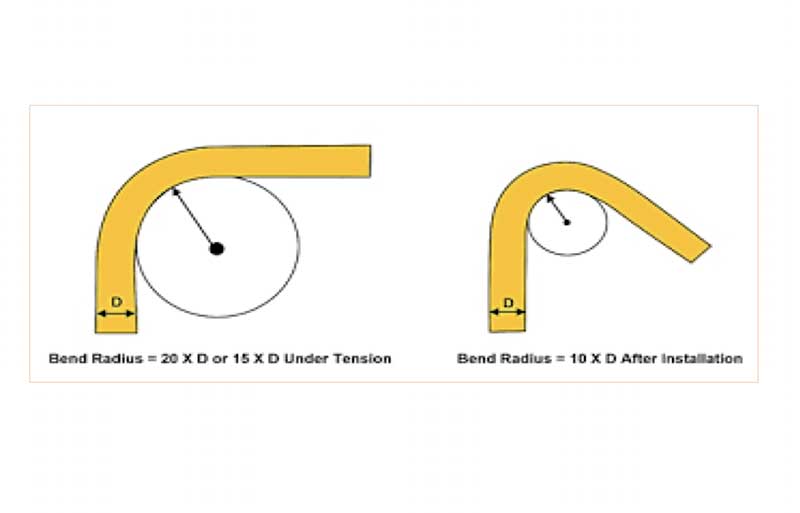
Patch Cord Stress: The Impact of Violating Minimum Bend Radius
Excessively tight bends introduce microscopic structural deviations in the fiber. Although these imperfections are subtle, they accumulate along the fiber axis and increase loss. Moreover, such bending weakens signal stability in environments like data centers, telecom backbones, and Fibre Channel storage networks. Therefore, maintaining the manufacturer-specified bend radius is crucial for ensuring long-term reliability.
Why Patch Cord Quality Standards Matter
Reliable Patch Cord performance depends on precise ferrule concentricity, accurate end-face curvature, and high-grade ceramic materials. Even slight deviations can disrupt coupling efficiency or accelerate wear. Additionally, contamination—no matter how small—must never be ignored. This seemingly minor issue may escalate into large-scale service disruption, unnecessary hardware replacement, and rising operational costs. Consequently, proactive inspection and proper handling remain essential practices for every optical network operator.
Maintaining a Healthy Optical Network Starts With the Patch Cord
Although often overlooked, the Patch Cord forms the foundation of every optical link. When contamination, bending stress, or poor manufacturing quality affects its performance, the entire network suffers. Therefore, consistent cleaning, routine inspection, and adherence to installation standards are indispensable for preventing downtime and reducing packet loss. As networks continue to scale, well-maintained Patch Cords will remain the key to sustaining high-speed, stable, and efficient communication.