
The transition from CWDM to DWDM marks a major leap in optical communication. As data demands grow rapidly, network operators must adopt solutions that deliver both high capacity and long-distance performance. Therefore, understanding this evolution helps enterprises plan future-proof network architectures.
CWDM: The First Step Toward Efficient Wavelength Use
Commercial Emergence and Technical Features
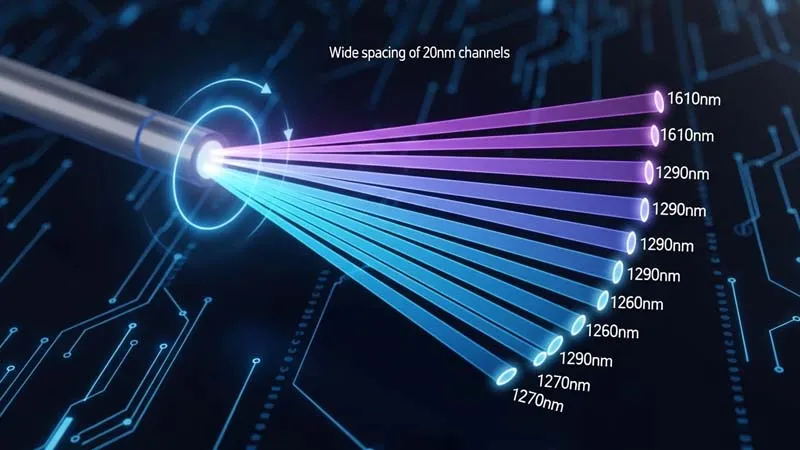
CWDM technology entered commercial use in the late 1990s and early 2000s. It features a wide channel spacing of 20 nm and typically supports 18 wavelengths from 1270 nm to 1610 nm. Because of this wide spacing, CWDM performs well in short-distance and cost-sensitive scenarios, especially below 80 km.
Application Strengths
CWDM is widely deployed in metro networks. It works best in situations where capacity requirements are moderate, usually at 2.5Gbps or below 10Gbps. Moreover, its low cost enables operators to expand bandwidth quickly without heavy investment.
Limitations of CWDM
However, its wide spacing also limits total system capacity. As global data traffic continued to surge, CWDM soon became insufficient for backbone networks. This limitation directly accelerated the technological shift from CWDM to DWDM.
DWDM: A Breakthrough in Capacity and Distance
Rise of High-Density Wavelength Multiplexing
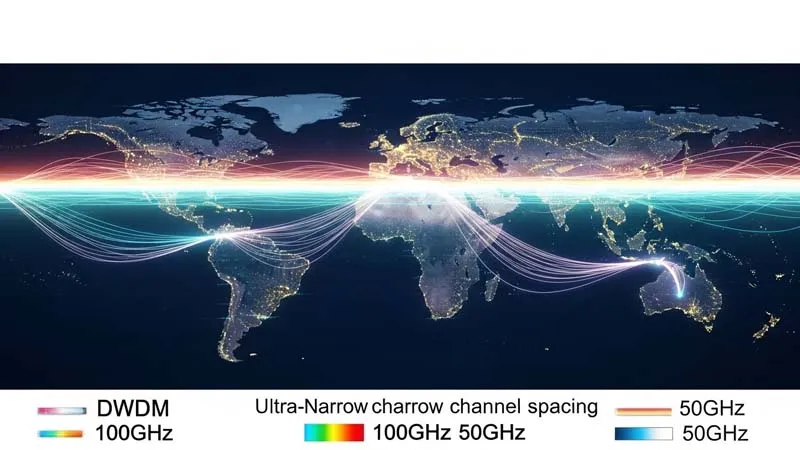
DWDM emerged earlier than CWDM, with core ideas developed in the early 1990s. Yet its large-scale deployment did not begin until the mid-to-late 1990s. Initially, the channel spacing was 1.6 nm (200 GHz). Later, it narrowed to 0.8 nm (100 GHz) and 0.4 nm (50 GHz), which dramatically increased wavelength density.
Unprecedented Capacity Expansion
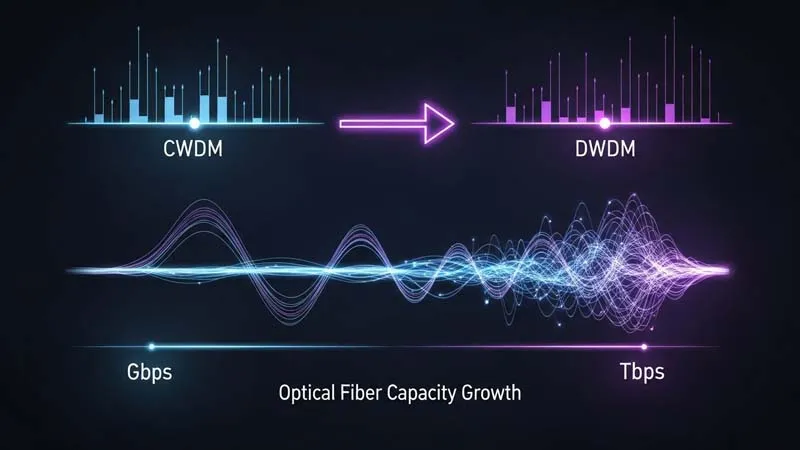
By shifting from CWDM to DWDM, the industry achieved a massive capacity jump—from Gbps-level transmission to Tbps-level performance. Consequently, DWDM enabled ultra-high-speed optical trunk lines that span continents and oceans. Today, it is the structural foundation of modern Internet backbone networks.
Complementary Roles Between CWDM and DWDM
Importantly, DWDM did not entirely replace CWDM. Instead, the two systems formed a complementary ecosystem. CWDM remains valuable in short-distance metro networks, while DWDM serves long-distance, high-capacity backbones. Together, they support growing global communication demands.
From CWDM to DWDM: A Natural Evolution
The evolution reflects a clear shift in network needs—from “basic availability” to “extreme performance.” As users demanded more bandwidth and higher service quality, optical technologies continued to improve wavelength accuracy, spectral density, and link efficiency.
At the same time, breakthroughs such as EDFA amplifiers further enabled long-distance, massive-capacity transmission. As a result, DWDM became the leading technology for next-generation optical communication.
A Defining Path of Optical Network Growth
The historical journey from CWDM to DWDM demonstrates the industry’s commitment to meeting soaring data demands. CWDM played the role of an economic enabler, while DWDM became the pioneer of ultra-large-capacity networks. Together, they shaped the current landscape of global fiber-optic communication.