
EDFA plays a crucial role in today’s optical communication infrastructure. It operates in the 1550 nm band and directly amplifies weak signals at the optical layer. Therefore, it effectively compensates for fiber attenuation and enhances long-haul transmission performance. Moreover, its broadband gain and reliability make it indispensable for DWDM systems.
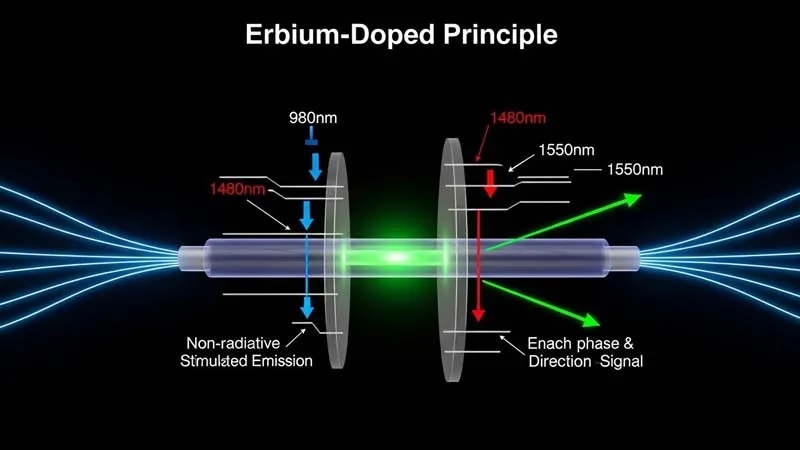
1. How EDFA Works
EDFA uses optical fibers doped with erbium ions (Er³⁺). When pump light at 980 nm or 1480 nm excites these ions, they rise to a higher energy state. As a result, when a 1550 nm signal passes through, the ions release photons with matching phase, frequency, and direction. Consequently, the original optical signal becomes stronger without undergoing electrical conversion.
Why This Matters
In addition, this all-optical process reduces distortion and minimizes noise accumulation. It also allows EDFA to support various modulation formats and bit rates without compatibility concerns.

2. Key Functions of EDFA in Communication Networks
2.1 Long-Distance Signal Transmission
Optical fibers experience attenuation of about 0.2 dB/km; however, compensates for this loss and therefore enables signals to travel across continents. Moreover, it dramatically reduces the number of regeneration stations required along the route, which lowers operational costs and complexity.
2.2 Full Optical Amplification
Traditional systems rely on repeated optical-electrical-optical conversions. However, EDFA amplifies signals entirely in the optical domain. Therefore, it maintains higher signal integrity and avoids unnecessary processing.
2.3 Support for DWDM Systems
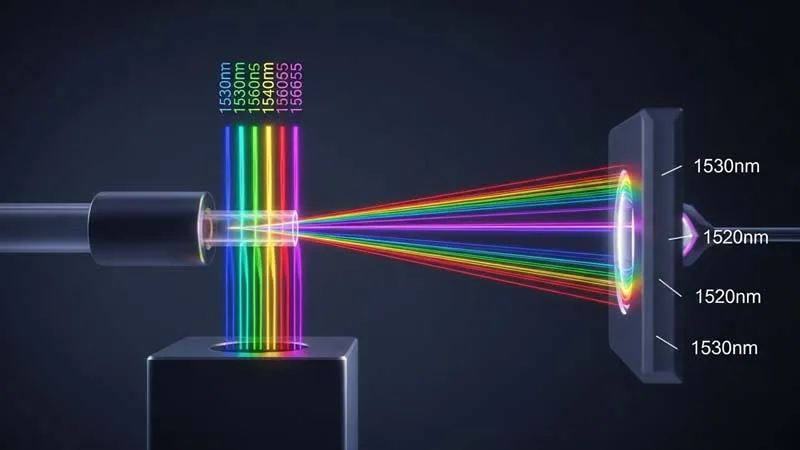
EDFA provides wideband gain in the C-band(1530–1565 nm), and consequently, it can amplify dozens or even hundreds of wavelength channels at the same time. Moreover, this capability significantly increases the available transmission capacity without major infrastructure changes.
2.4 Format-Transparent Operation
EDFA is also insensitive to transmission formats and rates. As a result, it seamlessly supports legacy systems and next-generation high-speed data services within the same network.
3. Application Positions of EDFA
3.1 Booster Amplifier
Located at the transmitter, it increases launch power so signals can travel farther.
3.2 In-Line Amplifier
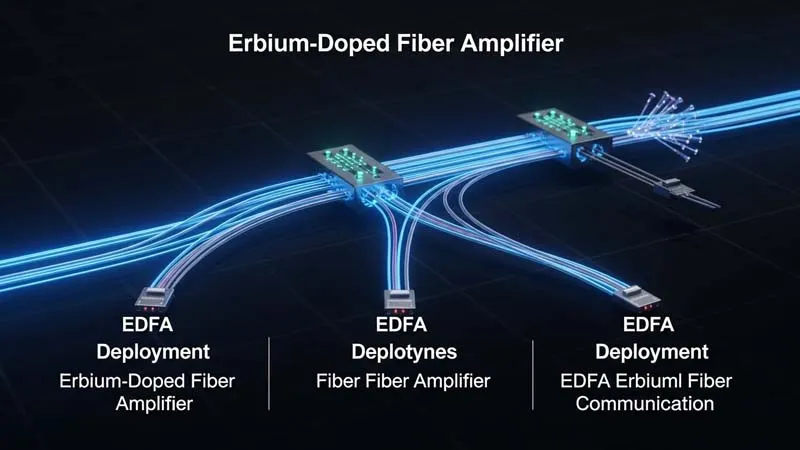
Placed in the middle of fiber routes, it compensates for attenuation in long spans. In addition, it ensures stable signal strength across the entire link.
3.3 Pre-Amplifier
Installed at the receiver, it strengthens weak incoming signals. Consequently, it improves receiver sensitivity and lowers bit-error rates.
4. Advantages and Limitations of EDFA
Advantages
- Low noise figure
- Adjustable gain with high stability
- Wide amplification bandwidth
- Strong compatibility with DWDM systems
- High reliability for long-term operation
Limitations
However, EDFA operates mainly in the C-band, and its gain spectrum does not cover all transmission windows. Therefore, some networks combine EDFA with other types of amplifiers to achieve broader wavelength support.
EDFA amplifies optical signals directly in the 1550 nm band and therefore improves long-distance, high-capacity transmission performance. Moreover, it supports multi-channel DWDM operation and ensures transparent signal processing. As a result, EDFA remains a foundational component of modern optical communication systems and will continue to play a central role in future fiber networks.