
DWDM is redefining the foundation of modern digital infrastructure. As global data traffic accelerates across AI, cloud computing, and IoT applications, traditional networks face increasing pressure. Therefore, organizations must adopt scalable and sustainable transmission technologies that support the next decade of growth. DWDM has emerged as the strategic solution for this transformation.

- DWDM Breaks Bandwidth Barriers and Unlocks Massive Capacity
Traditional optical fibers carry only a single wavelength, which imposes capacity limits. resolves this challenge by transmitting many wavelengths in parallel on one fiber. As a result, it dramatically increases total throughput without replacing existing fiber infrastructure.
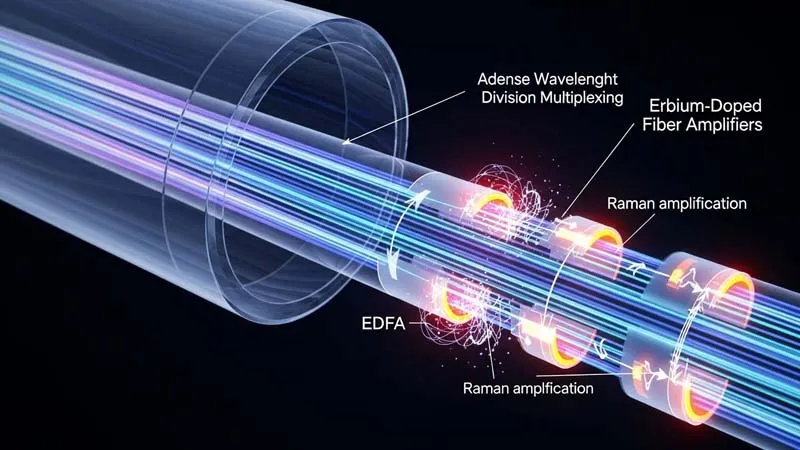
Key advantages include:
1.1 Ultra-High Capacity
DWDM enables multi-terabit transmission using dense wavelength channels. Moreover, new coherent technologies such as 400G, 800G, and 1.6T continue to raise performance ceilings.
1.2 Stable Long-Distance Transmission
With EDFA and Raman amplification, maintains high-quality signals across long distances. Therefore, it fits regional, national, and cross-border backbone deployments.
1.3 Exceptional Scalability
New wavelengths can be added flexibly. In addition, system upgrades do not require changing the underlying fiber, which reduces long-term CAPEX and OPEX.
1.4 Future-Ready Network Evolution
DWDM supports IP-over-DWDM architectures, multi-band expansion, and open optical systems. Consequently, it provides continuous adaptability for future network requirements.
- DWDM Accelerates AI, Cloud, and Global Data Center Interconnect
AI models, cloud platforms, and distributed data centers generate massive bidirectional traffic. However, eliminates distance limitations and ensures high-capacity transmission across all regions.

2.1 AI Compute Interconnect
Modern AI workloads require rapid communication between thousands of GPUs. Moreover, cross-region task scheduling generates huge east-west flows. DWDM, supported by 800ZR+ and next-generation coherent modules, meets these demanding requirements.
2.2 Multi-Region Cloud Network Expansion
Cloud service providers use DWDM to connect core regions, edge zones, and distributed clusters. As a result, data replication, resource synchronization, and business continuity benefit from its consistent performance.
2.3 Unified Transport for Digital Industries
Future applications such as 5G, autonomous driving, smart cities, and industrial IoT demand reliable low-latency networks. In addition, DWDM provides the unified transport layer needed to sustain these services.
- DWDM Ensures Sustainable Ten-Year Network Flexibility
Global networks will evolve significantly in the coming decade. Meanwhile, DWDM already offers the scalability and elasticity required for long-term development.
3.1 Continuous Speed Evolution
400G is widely deployed today. 800G is accelerating adoption, and 1.6T plus 3.2T systems are under development. Moreover, coherent DSP improvements enhance energy efficiency and reduce costs.
3.2 Spectrum Expansion Across Multiple Bands
Networks are moving beyond the C band toward C+L and eventually S+C+L. Consequently, total available spectrum increases several times, creating more space for future traffic growth.
3.3 Open, Automated, and Intelligent Architecture
IP-over-DWDM simplifies network layers. Open Line Systems support interoperability across vendors. In addition, AIOps brings predictive maintenance and automated optimization.
- DWDM as the Backbone of Global Connectivity
Nations, hyperscalers, and subsea cable operators rely on DWDM as critical digital infrastructure. It supports ultra-long-haul transmission, national backbone upgrades, and cross-continental cloud deployments. Therefore, DWDM is now the universal foundation for worldwide digital services.
- DWDM Innovation Enabled by Strong Technology Partners
In a rapidly evolving DWDM ecosystem, choosing experienced and reliable partners is essential.
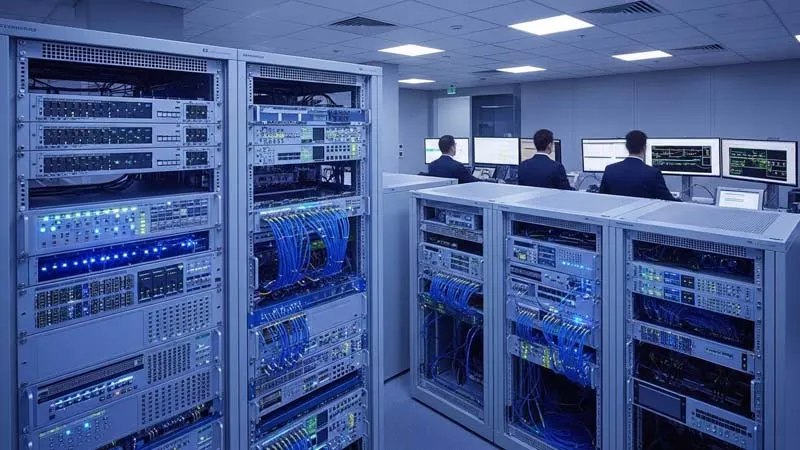
HTF is a global supplier of optical fiber products and WDM system solutions. The company is supported by a team with more than ten years of experience in optical R&D, fiber network design, and device manufacturing. Moreover, HTF provides end-to-end solutions for data centers, 5G networks, cloud platforms, metro networks, and access networks.
The HTF HT6000 is a compact, high-capacity, and cost-effective OTN transport system. It adopts a unified CWDM/DWDM platform, supports transparent multi-service transport, and enables flexible networking. As a result, the system delivers more than 1.6T of node capacity and is widely deployed in national backbones, provincial networks, and ISP/IDC expansion scenarios.
Through continuous innovation, HTF empowers global customers to build high-capacity optical networks for the next generation of digital infrastructure.