
Dense Wavelength Division Multiplexing (DWDM) is the backbone of modern optical communication networks. It enables massive data transmission by using multiple light wavelengths over a single fiber pair. To design a truly robust DWDM solution, engineers must balance performance, reliability, cost, and scalability. This guide outlines the essential factors to consider.
1. Understanding Capacity and Traffic Forecasting
Every effective DWDM design starts with accurate bandwidth planning. Network engineers should clearly identify:
- Current throughput needs: Consider total bandwidth for applications such as 5G backhaul, data center interconnects, and enterprise cloud services.
- Traffic growth rate: Typical annual growth ranges between 30% and 50%. Planning ahead helps avoid under-provisioning.
- Wavelength density: The number of channels depends on per-wavelength capacity and fiber type. Using 400G or 800G wavelengths improves fiber utilization and reduces channel count.
In summary, careful forecasting ensures that your DWDM network can scale efficiently as data demand rises.
2. Transmission Distance and Fiber Quality
Transmission distance greatly affects DWDM performance. Short-haul, metro, and long-haul deployments each require different components.
- Distance considerations: Long-haul links benefit from coherent transceivers and advanced digital signal processing.
- Fiber type: Compatibility with G.652, G.655, or G.657 fibers determines signal loss and dispersion management.
- Amplification: Use EDFA for C-band, Raman amplifiers for L-band, or hybrid systems for extended reach.
By matching fiber type and amplification strategy, network stability and signal integrity can be maintained even over long distances.
3. Component Compatibility and Interoperability
A DWDM network performs best when hardware and software integrate smoothly.
- Transceiver compliance: Ensure modules follow ITU-T standards and support form factors like QSFP-DD or CFP8.
- Mux/Demux and ROADM support: Verify channel spacing (25/50GHz) and wavelength band coverage.
- Open standards: Compatibility with OpenROADM and OTN protocols promotes flexibility and prevents vendor lock-in.
Consequently, interoperability improves network efficiency and simplifies future upgrades.
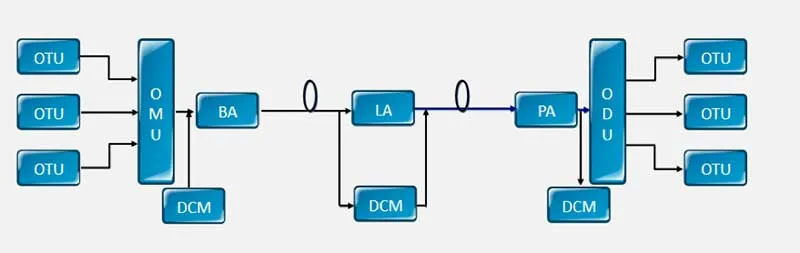
4. Ensuring Signal Integrity and Quality
Signal quality directly affects data reliability in DWDM systems.
- Nonlinear effects: Reduce SPM, XPM, and FWM by optimizing channel spacing and signal power.
- Dispersion control: Use DCMs or digital dispersion compensation to manage CD and PMD.
- Real-time monitoring: DDM and NMS tools should detect faults and optimize optical power automatically.
Therefore, continuous signal monitoring is essential to maintaining long-term transmission quality.
5. Power, Thermal, and Physical Constraints
Practical design considerations also play a major role.
- Power usage: Dense DWDM equipment can consume significant energy; cooling systems must match power density.
- Footprint efficiency: Compact transceiver formats help save rack space in data centers.
- Environmental resilience: Outdoor equipment should meet industrial temperature and durability standards.
Through efficient design, operational costs can be reduced while maintaining reliability.
6. Cost Efficiency and Total Cost of Ownership (TCO)
Cost balance is a cornerstone of a DWDM deployment.
- Component selection: Open hardware options lower CapEx but may require more configuration.
- Reuse infrastructure: Upgrade transceivers instead of replacing full line cards to minimize expenses.
- Reduce OpEx: Focus on remote management, power optimization, and hot-swappable components.
As a result, overall TCO decreases without sacrificing network performance.
7. Scalability and Future Readiness
A forward-looking DWDM solution must adapt to evolving technologies.
- Modulation flexibility: Support higher-order modulation to double capacity without replacing fibers.
- Band expansion: Upgrade from C-band to C+L band for additional wavelength support.
- Protocol evolution: Ensure compatibility with emerging standards like 2Tbps coherent transmission.
Ultimately, flexibility ensures that the DWDM network remains relevant as technology advances.
8. Security and Compliance
In critical sectors, DWDM security cannot be ignored.
- Layer 1 encryption: Implement AES-256 or Quantum Key Distribution for data protection.
- Regulatory compliance: Follow spectrum and data privacy regulations such as GDPR or HIPAA.
A secure and compliant DWDM network builds trust and safeguards sensitive information.
Designing a DWDM solution is both a technical and strategic task. By prioritizing capacity planning, component compatibility, signal quality, and cost control, network architects can deliver a scalable, energy-efficient, and future-proof infrastructure. With the right balance between innovation and practicality, a robust DWDM network will continue to power the world’s growing data needs for years to come.