
1. Overcoming Signal Attenuation in Long-Haul Transmission
In dense wavelength-division multiplexing (DWDM) systems, signal attenuation is a major challenge. Without an EDFA, a 100 km fiber link would lose around 25 dB of power—over 99% of its original strength.
An EDFA uses erbium-doped fiber and a 980 nm or 1480 nm pump laser to amplify optical signals directly, without electrical conversion. It can restore a -20 dBm signal to +5 dBm every 80–120 km. Therefore, EDFA technology enables reliable long-haul DWDM links extending beyond 200 km, forming the backbone of modern optical networks.
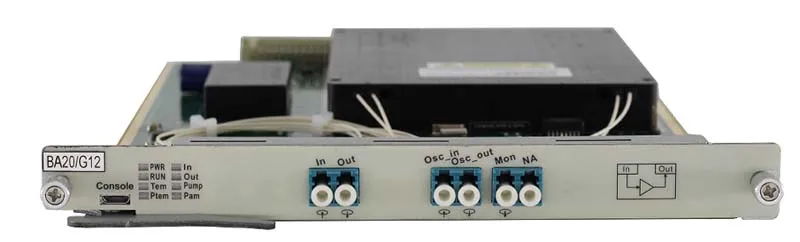
2. Multi-Wavelength Amplification for DWDM Density
Unlike earlier single-channel amplifiers, an EDFA supports simultaneous amplification of multiple wavelengths. It operates in the C-band (1530–1565 nm)—the primary range for DWDM transmission—covering up to 96 channels with 25 GHz or 50 GHz spacing.
As a result, a single EDFA can amplify all 96×400G channels (38.4 Tbps) at once, without crosstalk or manual tuning. This capability significantly enhances DWDM density, efficiency, and scalability, allowing operators to transmit massive amounts of data over a single fiber.
3. Preserving Signal Integrity for High-Speed DWDM
DWDM networks demand extremely low bit error rates (BER ≤ 10⁻¹²). EDFA amplifiers maintain signal integrity through two critical mechanisms:
- Low noise figure (NF 4–6 dB): This ensures minimal noise addition, preserving the signal-to-noise ratio essential for coherent transceivers such as 400G QSFP-DD.
- Linear amplification: By operating within a linear range, EDFA devices avoid distortion, ensuring stability for high-order modulation formats like 16QAM and 64QAM.
Consequently, EDFA plays a vital role in maintaining clean and stable optical transmission for ultra-high-speed DWDM systems.
4. Lower Cost and Complexity Compared to Electrical Regeneration
Before EDFA technology emerged, long-distance optical links required electrical regeneration, which converted signals from optical to electrical and back again. This approach was costly, complex, and introduced latency.
Now, simplifies the entire process. It eliminates the need for regeneration, cutting total cost of ownership (TCO) and improving scalability. Moreover, when expanding DWDM systems from C-band to C+L band, operators only need to deploy L-band EDFAs, rather than redesigning the entire amplification infrastructure.
5. Seamless Compatibility with the DWDM Ecosystem
EDFA amplifiers integrate naturally with critical DWDM components:
- ROADMs (Reconfigurable Optical Add-Drop Multiplexers): EDFAs compensate for power loss during wavelength add/drop operations, supporting dynamic reconfiguration.
- Dispersion Compensation Modules (DCMs): In long-haul networks, EDFA units are typically paired with DCMs to restore power after dispersion correction, ensuring stable end-to-end transmission.
Through these synergies, EDFA technology ensures the optimal performance of complex DWDM architectures.
When EDFA Is Not Needed
While indispensable for metro, regional, and long-haul applications, EDFA may not be necessary for very short-haul DWDM links (≤40 km), where attenuation remains minimal. In such cases, passive DWDM systems can achieve sufficient performance without active amplification.
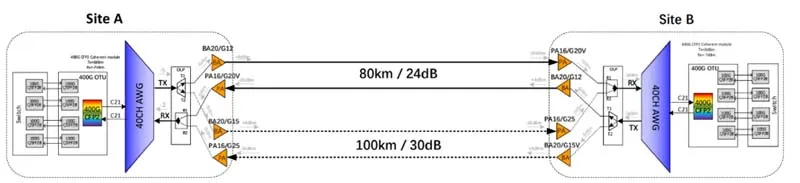
The stands as a foundational element in DWDM networks. It not only mitigates optical loss and maintains signal quality but also offers scalable and cost-effective amplification for high-capacity transmission.
As data demands continue to surge, EDFA amplifiers will remain a cornerstone technology—powering the evolution of global optical communication.