
In the era where “computing power is everything,” DWDM frontier technology (Dense Wavelength Division Multiplexing) has become a global focus in optical communications. As AI data centers, cloud networks, and 5G infrastructures grow rapidly, traditional optical transmission is reaching its physical limits. The challenge now is how to achieve ultra-low latency and ultra-high bandwidth at the same time — and DWDM frontier technology is leading that breakthrough.
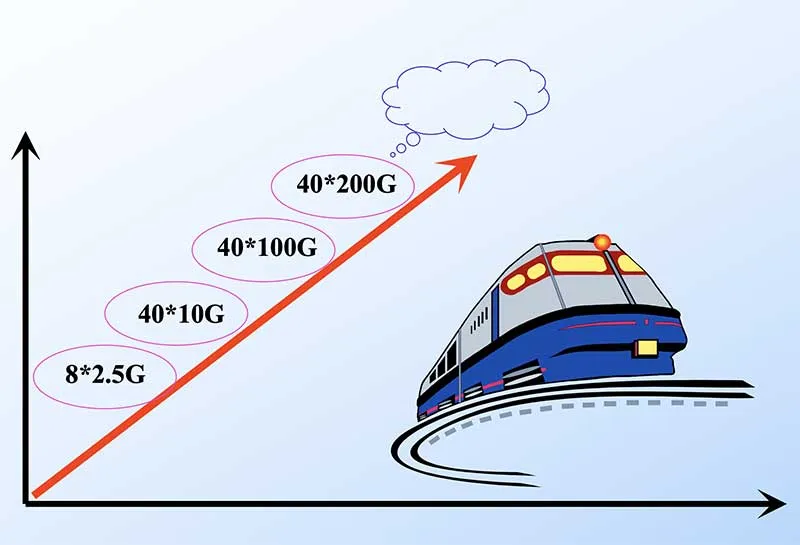
- When Physical Limits Approach, Innovation Becomes the Only Way Forward
With global data traffic exploding, DWDM systems face increasingly complex demands. Even though modulation and wavelength stacking technologies continue to improve, they are still limited by optical noise and nonlinear effects. When single-fiber transmission nears 1.6 Tbps, balancing bandwidth, power, and heat dissipation becomes critical.
The core goal of DWDM frontier technology is to push beyond these limits and redefine the boundaries of optical communication.
- The Evolution of DWDM: From Bandwidth Stacking to Intelligent Spectrum Control
The history of DWDM is a story of constant pursuit of efficiency. From early fixed-grid multiplexing to flexible-grid (Flex-Grid) designs, and now to AI-based spectrum optimization, DWDM has evolved from simple “capacity stacking” into “intelligent management.”
This evolution improves transmission capacity and spectrum use while providing the foundation for AI data centers, cloud interconnection, and large-scale network backbones. Future DWDM systems will feature smart wavelength allocation, adaptive power control, and predictive error correction — making optical networks more efficient and self-aware.
- Hollow-Core Fiber: Breaking the Limits of Latency
Among all DWDM frontier technologies, hollow-core fiber is one of the most exciting breakthroughs. Unlike traditional fibers made of glass, hollow-core fibers guide light through air, reducing dispersion and nonlinear interference.
Tests show they can reduce latency by 47% and increase capacity by up to 300% — ideal for high-frequency financial trading, distributed AI computing, and quantum communication.
Today, European and Japanese teams have achieved 100-kilometer-scale demonstrations, while Chinese manufacturers are rapidly improving packaging and stability. Once commercialized, hollow-core fiber will allow DWDM networks to balance low latency and massive bandwidth perfectly.

- Silicon Photonics and CPO: Toward “Chip-to-Light” Integration
As AI models grow larger, data center interconnection has become a bottleneck. DWDM frontier technology is now entering a new phase through Silicon Photonics (SiPh) and Co-Packaged Optics (CPO).
Silicon Photonics uses CMOS-compatible manufacturing to integrate optical and electronic components, lowering cost and power consumption. CPO places the optical engine and switch chip on the same substrate, minimizing signal loss and cutting energy per bit by 30%–50%.
These technologies make 800G, 1.6T, and even 3.2T systems possible — helping AI computing centers move from “electrical interconnects” to “optical interconnects.” The fusion of SiPh, CPO, and DWDM will shape the next-generation data-center architecture.
- Intelligent DWDM Networks: AI-Driven and Self-Optimizing
In the intelligent era, DWDM networks are no longer passive data pipelines. They are evolving into systems that can sense and adapt.
Through machine learning, DWDM networks can automatically optimize wavelength allocation, power levels, and error rates, and even repair link faults in real time.
This means future DWDM networks will be self-adjusting, self-healing, and self-optimizing, improving reliability while reducing operational costs — a true nervous system for AI data infrastructure.

- Global Landscape and Industry Competition
Across the world, DWDM frontier technology is becoming a key area of competition:
- The United States leads with Silicon Photonics ecosystems and CPO standards.
- Japan and Europe are ahead in hollow-core fiber manufacturing.
- China has strong system design and rapid industrialization, leading DWDM deployment in AI and 5G networks.
Whoever succeeds in commercializing hollow-core fibers, Silicon Photonics, and smart DWDM networks first will define the next era of optical connectivity.
- Toward “Optical Interconnection 3.0”
When bandwidth expansion reaches physical limits, DWDM’s mission evolves from “capacity increase” to “system transformation.”

The new “Optical Interconnection 3.0” era will be defined by intelligence, low latency, and chip-to-light integration.
Future DWDM networks will act as the nervous system of AI infrastructure, combining hollow-core fibers, CPO, and AI algorithms to deliver self-learning, energy-efficient data transmission — the foundation of a faster, greener digital world.
- Innovation Lights the Way Forward
Every leap in optical communication is a battle against physical boundaries. From DWDM to hollow-core fibers, from Silicon Photonics to CPO, each step aims to make light travel faster and smarter.
The vision of DWDM frontier technology is not only about speed and capacity — it’s about redefining intelligence in the information age.
In this global wave of optical innovation, HTF continues to play a vital role with its deep R&D expertise and engineering strength.
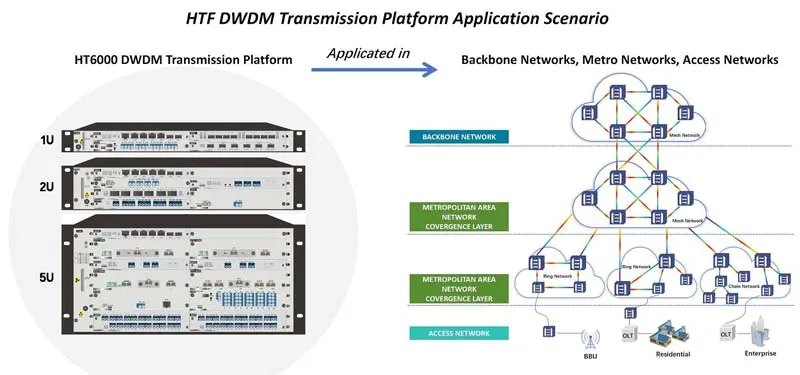
As a professional provider of optical fiber products and WDM system solutions, HTF delivers reliable transmission systems for data centers, 5G networks, cloud computing, and metro networks. Its flagship product, HTF HT6000, is a compact, high-capacity, and cost-effective OTN transmission platform. It supports multi-service transparent transport, flexible network topology, and capacities beyond 1.6 T, making it ideal for national, provincial, and metropolitan backbone networks.
Driven by innovation, HTF helps global customers build, connect, and optimize optical infrastructure, bringing light to the future of interconnection.