
In the fast-paced world of telecommunications, where data traffic grows exponentially by the day—driven by 5G, cloud computing, IoT, and high-definition streaming—the need for flexible, efficient, and scalable optical networks has never been greater. At the core of this evolution lies a game-changing technology: Wavelength Selective Switch (WSS). More than just a component, WSS is the backbone that empowers telecom operators to unlock the full potential of their optical infrastructure, ensuring seamless data transmission, dynamic bandwidth management, and future-ready connectivity.
What Is WSS, and Why Does It Matter for Telecom?
A Wavelength Selective Switch is a key optical device that enables precise control over individual wavelengths (or “colors”) of light in a dense wavelength division multiplexing (DWDM) system—the technology that allows telecom networks to transmit massive amounts of data over a single fiber optic cable by splitting it into multiple wavelengths. Unlike traditional fixed optical components, WSS offers dynamic, software-defined control: it can route, switch, or block specific wavelengths at will, without the need for manual reconfiguration.
For telecom operators, this dynamic control is transformative. In an era where data demands fluctuate wildly—think peak hours for video streaming, sudden surges in IoT device connectivity, or urgent needs for dedicated bandwidth for enterprise clients—WSS eliminates the rigidity of fixed networks. It turns static fiber infrastructure into a flexible, adaptive system that can respond to changing demands in real time, reducing downtime, cutting operational costs, and improving overall network efficiency.
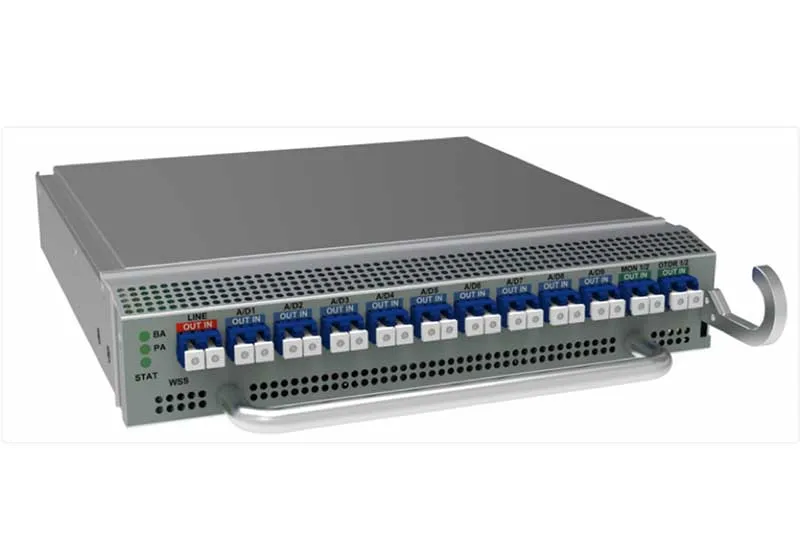
The Core Advantages of WSS for Telecom Networks
WSS isn’t just a “nice-to-have” upgrade; it’s a necessity for telecom operators looking to stay competitive and meet the demands of modern connectivity. Here’s how it delivers unmatched value:
- Dynamic Bandwidth Allocation (DBA)
One of the biggest challenges for telecom networks is balancing bandwidth supply with demand. WSS solves this by enabling on-the-fly wavelength adjustment: if a region experiences a sudden spike in data usage (e.g., a major event with thousands of people streaming live), operators can reallocate unused wavelengths from less congested areas to the high-demand zone—all remotely, via software. This eliminates the need for costly and time-consuming on-site hardware changes, ensuring that bandwidth is always where it’s needed most.
- Enhanced Network Resilience
Network outages are costly for telecom operators—both in terms of revenue loss and reputational damage. WSS boosts resilience by enabling fast fault recovery. If a fiber link is damaged or a wavelength experiences interference, WSS can automatically reroute affected wavelengths to alternative paths in milliseconds. This “self-healing” capability minimizes downtime, keeping critical services (like 5G connectivity, enterprise VPNs, and emergency communications) up and running even in the face of disruptions.
- Support for 5G and Beyond
5G networks require ultra-low latency, high bandwidth, and massive connectivity—and WSS is essential to delivering on these promises. By enabling precise wavelength management, WSS supports the small cell deployments, edge computing integration, and backhaul/fronthaul optimization that 5G demands. For example, in 5G fronthaul networks (which connect cell towers to core networks), WSS can separate and route different wavelengths for voice, data, and IoT traffic, ensuring each service gets the latency and bandwidth it needs. As telecom operators move toward 6G, WSS will only become more critical, supporting even higher data rates and more complex network architectures.
- Cost Efficiency and Scalability
Traditional optical networks require significant upfront investment in fixed hardware, and scaling up (e.g., adding new wavelengths or expanding coverage) often means replacing or upgrading components. WSS changes this by offering pay-as-you-grow scalability. Operators can start with a base WSS configuration and add capacity (more wavelengths, wider coverage) via software updates, without replacing hardware. This reduces capital expenditure (CapEx) and operational expenditure (OpEx), as fewer on-site visits are needed for maintenance or upgrades.
✅ Title (≤ 50 characters)
✅ Keywords
, , , optical network, telecom, 5G, network resilience, bandwidth management, optical innovation
✅ Description (≤ 135 characters)