
In today’s fast-moving digital economy, DWDM industry trends are reshaping the global data transmission landscape at an unprecedented speed. From data centers to cloud computing, from 5G networks to artificial intelligence, every leap in optical communication represents a major step in the evolution of the information age.
DWDM (Dense Wavelength Division Multiplexing) has become the “data artery” of the AI era, leading the communication industry into a new age of extreme bandwidth, ultra-low latency, and intelligent management.

1. Global Digital Growth Drives Continuous Expansion
Data traffic is exploding worldwide. The rise of generative AI, massive 5G device connections, and cloud computing demand higher bandwidth and greater stability than ever before.
According to DWDM industry trends, the global market continues to grow at a compound annual rate of 8–10%, and the total market value is expected to exceed USD 20 billion within the next five years.
In China, national projects such as “Eastern Data, Western Computing” and the rapid construction of AI computing centers are accelerating upgrades of backbone networks, DCI interconnections, and metro optical networks.
DWDM, with its ability to carry hundreds of wavelengths in a single fiber, expands bandwidth by hundreds of times—becoming an essential foundation for the era of data explosion.
2. AI Becomes the Core Driving Force
AI is not only the source of massive data but also a key driver of network transformation.
Training large-scale AI models requires high-speed data exchange between nodes across multiple regions. Any delay can affect overall training efficiency.
The most striking change in DWDM industry trends is the growing need for ultra-low latency and high reliability to support AI workloads.
Today, AI data centers are reshaping optical networks. Companies such as Lightmatter, Nvidia, Huawei, and Cisco are integrating “AI Optical Interconnect” concepts into their data architectures, using DWDM to build programmable and adaptive optical networks.
These intelligent DWDM systems optimize bandwidth, reduce latency, and save energy—transforming traditional connections into self-learning “optical brains.”

3. Green and Efficient: The New Core Demand
Balancing energy efficiency and performance has become a central challenge for the optical communication industry.
Global data centers are improving their PUE (Power Usage Effectiveness) ratios, while DWDM systems are judged increasingly by their energy per bit.
Current DWDM industry trends show a clear move toward high bandwidth, low power, and compact design.
Next-generation coherent optical modules and silicon photonics (SiPh) technologies are improving cabinet density and cutting power consumption by more than 30%.
C+L band transmission expands available spectrum and boosts usable bandwidth by nearly 80%, providing strong support for green data centers.
China’s “Dual-Carbon” policy is also driving manufacturers toward sustainable, modular, and intelligent optical systems. As part of the global green infrastructure, DWDM technology is becoming a key player in the sustainable digital economy.
4. Technical Evolution: From 400G to 1.6T
Technology innovation remains the core power behind DWDM growth.
Commercial 400G systems are mature, while 800G and 1.6T deployments are accelerating worldwide.
New digital signal processors (DSP) and coherent optical modules ensure long-distance transmission with high signal integrity.
Meanwhile, software-defined optical networks (SDON) and AI-based control systems enable self-learning, self-optimization, and predictive maintenance.
The network is shifting from “passive response” to “active intelligence,” marking the true revolution of the AI era in DWDM.

5. Real-World Applications: Connecting Cloud, AI, and IoT
DWDM industry trends are not just about technology—they reflect a deep transformation in digital ecosystems.
DWDM is now widely used in:
Cloud Data Center Interconnection (DCI) – The preferred solution for public and private cloud connectivity;
5G Transport Networks – Supporting dense base station deployment with high-speed, low-latency links;
AI Computing Centers – Enabling high-speed optical channels for AI model training and inference;
Government and Research Networks – Ensuring secure, stable, and high-bandwidth data exchange.
DWDM is becoming the backbone of “Computing-Network Integration,” allowing data and computing power to flow efficiently at the speed of light.
6. Future Outlook: From Connection to Intelligence
Over the next decade, DWDM technology will continue to evolve toward:
Smarter Networks – AI-based self-healing and self-optimizing optical systems;
Higher Integration – CPO (Co-Packaged Optics) and silicon photonics for extreme density and efficiency;
Open Ecosystems – Multi-vendor collaboration through open interfaces;
Service Innovation – “Bandwidth as a Service” (BaaS) reshaping network business models.
DWDM will move beyond connecting data—it will manage and understand traffic intelligently, becoming the core infrastructure of the AI-driven digital economy.
7. Intelligent Light, Infinite Future
As AI illuminates the network’s foundation, DWDM stands at the heart of this transformation.
It carries massive data flows and witnesses the birth of intelligent connectivity.
From performance to sustainability, from speed to intelligence, DWDM industry trends are defining the future of global communication.
HTF — a professional provider of optical fiber products and WDM system solutions — has over 10 years of experience in optical communication R&D, production, and engineering.
HTF is dedicated to helping global data centers, 5G networks, cloud platforms, metro, and access networks build and optimize their optical infrastructure through advanced design, supply, and service.
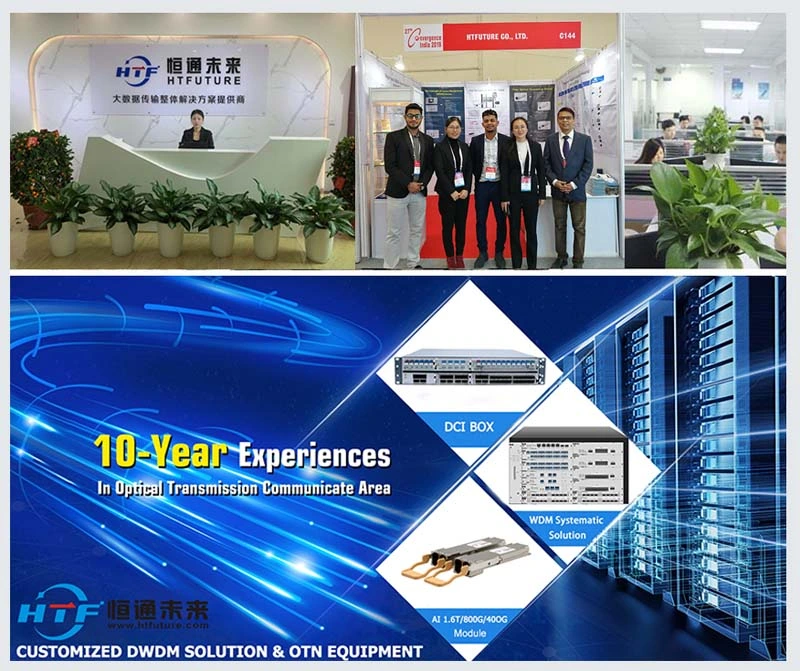
The company’s flagship product, HTF HT6000, is a compact, high-capacity, and cost-effective OTN transmission system based on a CWDM/DWDM universal platform. It supports multi-service transparent transmission, flexible networking, and large-scale deployment, meeting over 1.6T node capacity needs.
Widely used in national and provincial backbone networks as well as IDC environments, HTF HT6000 represents one of the most efficient and scalable DWDM solutions for modern data-driven operations—powering a greener, smarter, and more connected world.