
In the vast, interconnected world of modern communication, data travels on beams of light. At the core of this optical symphony is Wavelength Division Multiplexing (WDM), the technology that allows a single fiber to carry the immense burden of our digital lives. But if the fiber is the highway, and the light pulses are the cars, what orchestrates this incredibly dense, high-speed traffic to prevent a colossal collision?
The answer lies in an unsung hero, a pivotal component within every WDM system: the Multiplexer.
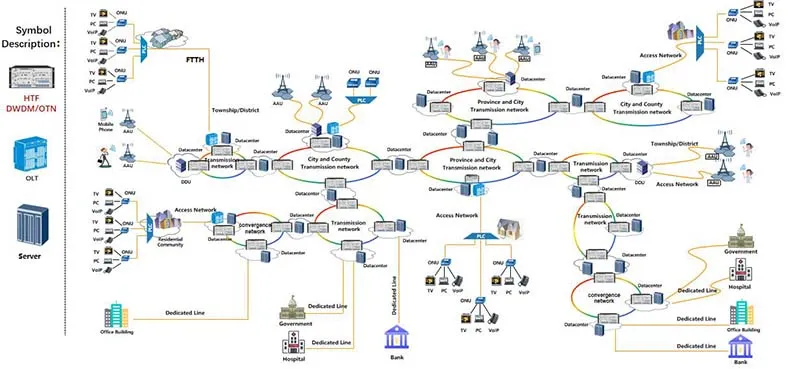
The Conductor of the Optical Orchestra
Imagine a bustling airport. Dozens of individual flights (data streams) arrive from different cities (networks). To efficiently transport them across an ocean, they are consolidated onto a few, massive jumbo jets (the optical fiber). The multiplexer is the air traffic control system that seamlessly merges these separate flights onto a single, powerful vessel.
In technical terms, a multiplexer (often abbreviated as MUX) is the device that takes multiple distinct optical signals, each carried on a unique wavelength of light (e.g., λ₁, λ₂, λ₃…), and combines them into a single, powerful beam that is launched into a single optical fiber. Without this crucial function, the incredible capacity of WDM would be impossible.
The Critical Role of the Multiplexer
The multiplexer’s role is deceptively simple yet fundamentally critical to the entire operation of a WDM network:
Creating Capacity: The primary job of the MUX is to unlock the latent potential of the fiber. A standard fiber can carry one light signal. A MUX allows it to carry 40, 80, or even more simultaneously. This multiplicative effect is the bedrock of scalable network expansion, preventing the astronomically expensive alternative of laying endless new cables.
Ensuring Signal Integrity: A high-quality multiplexer doesn’t just combine signals; it does so with extreme precision and minimal loss. It ensures that each wavelength channel remains isolated and does not interfere with its neighbors (minimizing crosstalk). This purity is essential for maintaining the integrity and quality of the data over long distances.
Enabling Bi-Directionality: In a typical WDM system, communication is two-way. This is achieved using a closely related component called the Optical Add-Drop Multiplexer (OADM). While a simple MUX combines signals, an OADM can selectively add or drop specific wavelength channels at intermediate points without disturbing the other channels passing through. This creates flexible, efficient network rings, crucial for metropolitan area networks (MANs) and modern 5G backhaul.
The Technology Behind the Magic
Multiplexers achieve this feat of light manipulation using sophisticated technologies. The most common types are:
Thin-Film Filter (TFF): Uses interference-based filters to selectively reflect or pass specific wavelengths. Known for excellent stability and channel isolation.
Arrayed Waveguide Grating (AWG): A planar lightwave circuit that uses an array of waveguides to diffract and combine light. Highly reliable and ideal for dense channel configurations in DWDM systems.
The Unsung Hero Powering Your World
The next time you experience a flawless video call, stream a 4K movie, or access mission-critical cloud data in an instant, remember the complex dance of light happening beneath the surface. The multiplexer is the silent, efficient, and brilliant conductor ensuring that every wavelength hits the right note.
It may not be the most glamorous component, but it is undoubtedly one of the most vital. In the quest for greater bandwidth and faster connectivity, the multiplexer remains a foundational pillar, truly proving that in unity—there is immense strength and speed.