
In the era of 5G, AI-driven data explosion, and cloud computing, optical communication networks face unprecedented demands for reliability and flexibility.
The Optical Line Protection-Bidirectional (OLP-BD) system emerges as a game-changing solution, offering dual-fiber redundancy in a single-fiber architecture to ensure seamless connectivity even in the face of fiber cuts or equipment failures. This article delves into the technical principles, core advantages, and real-world applications of OLP-BD, showcasing its pivotal role in building next-generation optical infrastructure.
1.Fundamentals of OLP-BD: Precision Protection with Single-Fiber Efficiency
OLP-BD is an advanced optical protection system designed to monitor and switch optical signals in real time while optimizing fiber resource utilization. Unlike traditional 1+1 or 1:1 OLP systems that require dedicated backup fibers, OLP-BD employs bidirectional transmission over a single fiber, enabling:
Dual-Fiber Redundancy in Single-Fiber Infrastructure: Reduces fiber consumption by 50% while maintaining 99.999% uptime.
Ultra-Fast Switching: Fault detection and switching occur within ≤20ms , ensuring zero service interruption.
Transparent Signal Handling: Supports all wavelengths (1260–1650nm) and data rates (10G/100G/400G), making it compatible with DWDM, OTN, and coherent optical systems.

How It Works: The Bidirectional Protection Mechanism
Dual-Path Monitoring
OLP-BD continuously monitors both directions of a single fiber using optical power sensors and micro-electromechanical systems (MEMS) switches. If the primary path’s power drops below a threshold (e.g., due to fiber breakage), the system triggers an automatic switch.
Intelligent Rerouting
The MEMS switch redirects traffic to a redundant fiber or path within milliseconds. Unlike unidirectional OLP, OLP-BD ensures bidirectional traffic resilience, critical for applications like 5G backhaul and data center interconnections (DCI) .
Self-Healing Capability
Once the primary path is restored, OLP-BD automatically reverts to normal operation, eliminating manual intervention.
2.Core Advantages of OLP-BD
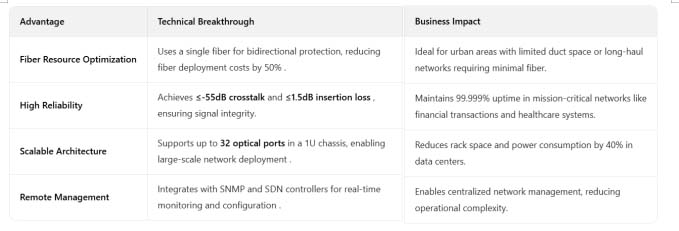
OLP-BD outperforms traditional OLP systems with its efficiency, scalability, and cost-effectiveness:
3.Real-World Applications
OLP-BD is reshaping optical networks across industries:
5G/6G Mobile Backhaul
In 5G networks, OLP-BD ensures on-demand bandwidth allocation and rapid fault recovery. For example:
Dynamic Traffic Adjustment: During peak hours, OLP-BD can allocate additional wavelengths to high-traffic base stations while scaling down resources in low-demand areas.
Seamless Service Continuity: If a fiber in a 5G backhaul link is cut, OLP-BD switches traffic to a backup path within 20ms, preventing disruptions to 4K streaming or autonomous driving data transmission .
Data Center Interconnections (DCI)
With AI-driven data centers demanding 100G/400G/800G links, OLP-BD optimizes DCI networks by:
Bandwidth Expansion: Supporting C+L full-band operation (12.5THz total capacity) to meet ultra-high-speed inter-DC requirements.
Latency Reduction: Reduces inter-DC latency by 15–20% compared to traditional networks , critical for real-time AI model training and cloud gaming.
Industrial Automation
In smart factories, OLP-BD ensures uninterrupted machine-to-machine (M2M) communication:
Predictive Maintenance: Monitors optical signals to detect early signs of fiber degradation, enabling proactive maintenance.
Process Automation: Supports deterministic latency for robotic control and quality inspection systems, improving production efficiency by 25% .

Power Grid and Critical Infrastructure
OLP-BD is used in power grids to protect SCADA systems and substation communication:
Grid Stability: Ensures real-time monitoring of power distribution, preventing blackouts caused by fiber failures.
Security Compliance: Meets stringent cybersecurity standards by isolating critical control systems from external threats .
The OLP-BD system is the cornerstone of modern optical networks, delivering the agility and resilience required for 5G, AI, and cloud computing. Its ability to dynamically manage bidirectional traffic while optimizing fiber resources ensures optimal resource utilization, reduces operational costs, and future-proofs infrastructure.
As optical networks evolve toward “ultra-large capacity, ultra-low latency, and full intelligence,” OLP-BD will remain indispensable in building the networks of tomorrow.