
800G ZR+ Pluggable Optical Module technology is rapidly emerging as a foundational building block for next-generation AI data center interconnection. As large-scale AI models continue to expand, computing demand grows exponentially. However, traditional centralized AI data centers are increasingly constrained by power availability, cooling capacity, and physical infrastructure limits. Consequently, cloud service providers are shifting toward distributed AI data center architectures, which directly accelerates demand for high-capacity, long-reach optical interconnect solutions.

Power Constraints Are Reshaping AI Data Center Architectures
AI workloads rely heavily on dense GPU clusters, which consume enormous amounts of power. In many regions, power grid expansion cannot keep pace with the rapid deployment of new AI infrastructure. As a result, building ever-larger centralized AI data centers has become both costly and impractical.
Therefore, cloud operators are adopting geographically distributed AI data centers, typically spaced 50 to 150 kilometers apart. This approach allows operators to leverage regional power resources more efficiently. At the same time, it enables flexible capacity expansion. However, distributed deployment also introduces a critical challenge: how to interconnect these AI nodes with ultra-high bandwidth and minimal latency.
Distributed AI Requires a New Level of Interconnection
In distributed AI environments, the network no longer serves as a simple data transport layer. Instead, it becomes an essential component of the computing fabric. Model synchronization, gradient exchange, and collaborative inference all depend on stable, deterministic, and high-throughput inter-data-center connectivity.
As a result, conventional DCI solutions struggle to meet these demands. Long-distance links must now deliver near–data center–class performance. Under these conditions, the 800G ZR+ Pluggable Optical Module provides a highly effective solution by combining high capacity, extended reach, and operational simplicity.

Why 800G ZR+ Represents a Critical Technology Breakthrough
ZR+ technology is designed for metro and regional DCI applications. Compared with standard ZR, ZR+ offers higher optical budgets and stronger link adaptability, enabling transmission over distances ranging from 80 km to several hundred kilometers. When paired with 800G capacity, the result is a significant leap in bandwidth efficiency.
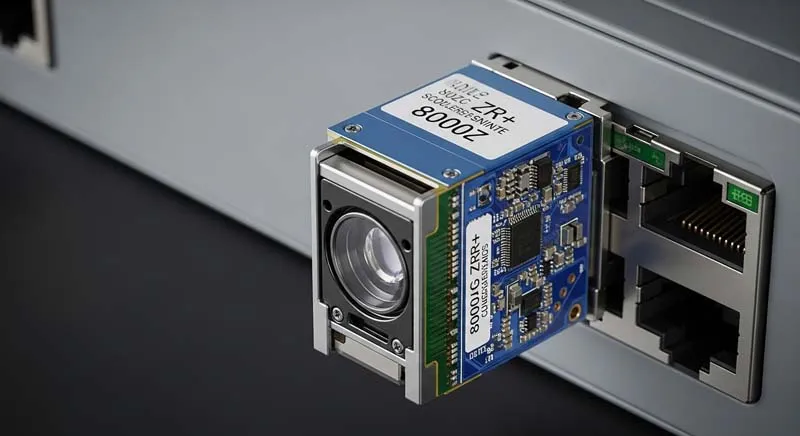
Moreover, the pluggable form factor fundamentally changes network design. Instead of relying on dedicated coherent line cards, operators can deploy 800G ZR+ Pluggable Optical Module solutions directly within high-performance switches and routers. Consequently, IP and optical layers become more tightly integrated, reducing system complexity and accelerating deployment cycles.
From DCI to Compute Interconnect: A Role Transformation
Traditionally, DCI networks focused on data replication and service continuity. However, in distributed AI architectures, interconnection links now function as “compute highways.” They directly enable the aggregation of geographically dispersed computing resources into a unified virtual AI factory.
Therefore, network performance directly influences AI training efficiency. High-capacity coherent optics reduce fiber consumption while improving scalability. In this context, the 800G ZR+ Pluggable Optical Module becomes a strategic asset rather than a simple connectivity component.
Industry Impact and Ecosystem Evolution
This technological shift is reshaping the optical networking ecosystem. On one hand, network equipment architectures are evolving toward IPoDWDM integration. On the other hand, optical module vendors face higher technical thresholds in DSP algorithms, coherent optics design, and power optimization.
At the same time, cloud providers are gaining greater influence over specifications and deployment models. As these trends continue, 800G ZR+ Pluggable Optical Module solutions are moving rapidly from pilot deployments to standardized configurations.
2026 Outlook: Accelerated Adoption Becomes Inevitable
Looking ahead, power constraints will remain a long-term challenge. Meanwhile, AI computing demand will continue to rise. Therefore, distributed AI data centers are expected to become a mainstream deployment model rather than an exception.
As this transition accelerates, the market for 800G ZR+ Pluggable Optical Module solutions will expand accordingly. Industry analysis suggests that shipment volumes could surge around 2026, marking a clear inflection point in coherent optics adoption for AI-driven networks.

Building a Future-Proof Optical Infrastructure
In this evolving landscape, experienced optical networking solution providers play a vital role. HTF is a professional supplier of fiber optic products and WDM system solutions, backed by a team with over ten years of experience in optical communication R&D, component development, and manufacturing. HTF focuses on helping customers build, connect, and optimize fiber infrastructure for global data centers, cloud computing networks, metro networks, and access networks.
For example, the HTF HT6000 is a compact, high-capacity, and cost-effective OTN transmission system. Based on a CWDM/DWDM universal platform, it supports transparent multi-service transmission and flexible networking. With node capacities exceeding 1.6T, it provides a highly efficient WDM expansion solution for IDC and ISP operators. Such platforms form a solid foundation for large-scale optical networks as distributed AI interconnection continues to evolve.