
59% of operators will adopt IPoDWDM. The era of IP and optical network convergence has arrived.
Communications service providers are significantly increasing their adoption of IP over DWDM, with 59% of 400G+ pluggable optical modules expected to be used in routers within three years. 43% of operators plan to deploy 800G standard modules within a year, but operational complexity in a multi-vendor environment remains a challenge.
ICC News: On July 15, 2025, Heavy Reading (now part of Omdia) released a global IP over DWDM (IPoDWDM) adoption survey, noting that while 400ZR coherent pluggable optical modules were initially driven by hyperscale cloud providers, communications service providers (CSPs) are accelerating their shift to converged IP and optical network architectures. The survey, conducted in partnership with Ciena and covering 240 operators worldwide, is the largest industry survey to date.
Architectural Transformation Accelerates
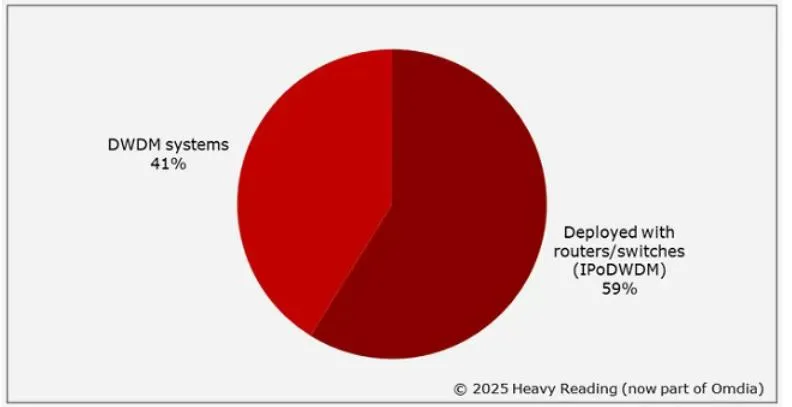
Survey data shows that within three years, operators expect 59% of 400G+ pluggable optical modules to be deployed in IPoDWDM equipment, while the proportion of traditional optical transmission equipment will drop to 41%. This ratio is a sharp reversal from the 2022 survey results (61% traditional optical transmission/39% IPoDWDM). In traditional DWDM systems, pluggable modules are evenly distributed across metro and long-haul networks; in IPoDWDM scenarios, metro networks have a slightly higher share than long-haul networks.
By the end of 2027, how do you envision the distribution of 400G+ coherent pluggable optical modules across different applications in your network?
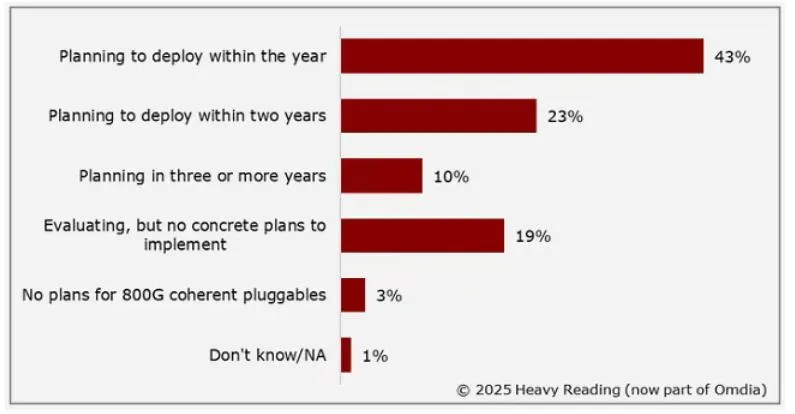
Hardware Evolution Trends: When selecting coherent pluggable modules, operators prioritize both standardization and high-performance transmission modes. 52% of respondents are “very willing” to adopt proprietary optical modules for performance advantages, while 38% are “somewhat willing” but evaluate the situation accordingly. With the OIF 800ZR standard set to be finalized in October 2024, 800G coherent pluggable modules have become a hot topic: 43% of operators plan to deploy them within a year, and 23% within two years. Notably, many operators plan to achieve longer transmission distances at 400G speeds using next-generation optical modules.
A parallel wave of router upgrades is also underway. Some operators are deploying 800G-compatible routers even faster than the optical modules themselves. 800G port capabilities have become a core requirement in router refresh cycles, even if there are no immediate plans for their implementation.
When do you plan to deploy 800G coherent pluggable optical modules in your network?
Software Challenges Highlighted: While operators are turning to IPoDWDM to improve operational efficiency, operational complexity in multi-vendor optical network environments remains a major obstacle. This makes IPoDWDM software features crucial, including unified operation of pluggable modules, open API management interfaces, and multi-vendor control capabilities covering both IPoDWDM and traditional transport.
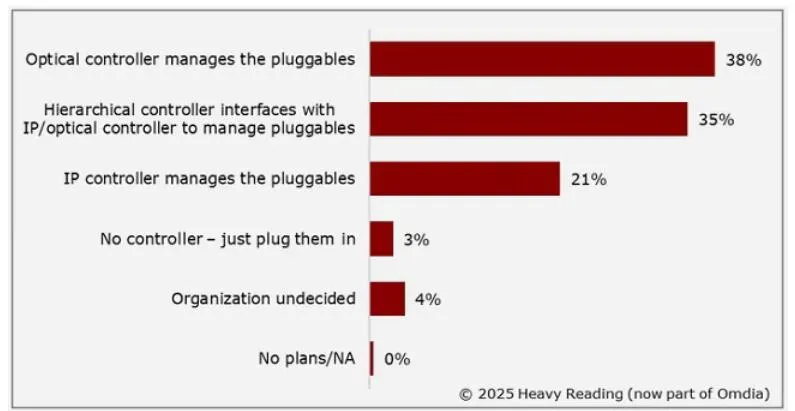
In terms of management strategy, 38% of operators prefer optical layer controllers to manage pluggable modules, 35% prefer hierarchical controllers, and 21% favor IP controllers. The survey found that respondents’ roles within the enterprise significantly influenced their preferences: optical network teams preferred optical layer control, while IP teams favored IP control.
Heavy Reading believes this will be an ongoing topic of discussion in the industry. What is your preferred strategy for managing coherent pluggable modules in routers?
“Although the road to IP and optical network convergence has experienced twists and turns, survey data from the past five years clearly shows that this has become an irreversible industry trend,” said Sterling Perrin, senior principal analyst at Heavy Reading.