
Quantum computing threatens traditional encryption. Quantum Key Distribution (QKD) offers a solution. It ensures secure key sharing using quantum physics. In July 2025, PacketLight Networks and NEC demonstrated a breakthrough. They integrated QKD with 400G Dense Wavelength Division Multiplexing (DWDM) in Japan. Their approach uses separate fibers for quantum and data signals. This achieves 100% throughput with low latency. Moreover, it provides a cost-effective upgrade for quantum-secure communication. This article analyzes the technology, its implementation, and its impact on the industry.
Technical Background
QKD leverages quantum principles, like the no-cloning theorem, to distribute secure keys. It uses photons for transmission. Conversely, DWDM enables high-capacity data transfer. It sends multiple wavelengths over a single fiber. Today, 400G DWDM networks are common. However, combining QKD with DWDM is challenging. Quantum signals are fragile. Noise or high-power data signals can disrupt them. This reduces key generation rates or impacts data performance.
PacketLight and NEC tackled this issue. In NEC’s Japan lab, they used PacketLight’s PL-4000M 600G Muxponder and NEC’s QKD system. Their solution proved practical and scalable.
Core Technical Analysis
Technical Solution Overview
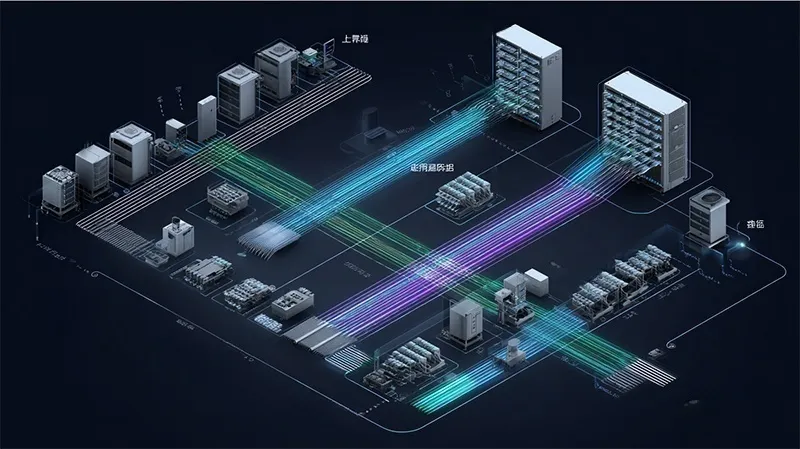
The breakthrough uses a dual-fiber setup. Quantum signals travel through a dedicated fiber. Data signals use the main DWDM link. This separation prevents interference. It ensures quantum signal stability and maintains 400G data performance. Tests confirmed 100% throughput with minimal latency. NEC’s QKD system integrates seamlessly with PacketLight’s equipment. A 100GbE tester validated the results. This setup delivers both security and efficiency.
Benefits of Dedicated Fiber
Using a separate fiber for quantum signals is key. It offers clear advantages:
– Quantum Signal Protection: Photons are sensitive. Dedicated fiber avoids noise from DWDM signals. This ensures stable key generation.
– Data Performance: The DWDM link handles 400G data without compromise. Tests showed full throughput and low latency.
– Scalability: The solution fits existing DWDM networks. No major upgrades are needed. This reduces deployment costs.
Implementation Details
The QKD system generates keys via a quantum channel (Q-channel). It often uses the O-band (1310nm) or C-band. A dedicated fiber ensures stable transmission. Key Management Entities (KMEs) and Security Application Entities (SAEs) collaborate using REST API protocols. They distribute quantum keys for data encryption. PacketLight’s equipment employs GCM-AES-256 encryption. It also uses Diffie-Hellman key exchange (P-384 curve, SHA-384 authentication). This combination ensures robust security.
The choice of wavelength matters. O-band offers low loss for short distances. C-band aligns with DWDM compatibility. Dedicated fiber avoids signal degradation from multiplexers. NEC’s 20-year QKD expertise supports this integration. PacketLight’s CEO, Koby Reshef, stated, “NEC’s QKD enhances our DWDM solutions for secure data transfer.” NEC’s Yoichiro Ito added, “This demo proves our system’s versatility.”
Industry Impact and Applications
Industry Significance
This breakthrough transforms communication security. It integrates QKD with existing DWDM networks. No major infrastructure changes are needed. This lowers costs significantly. Telecom operators, data centers, and enterprises benefit. The solution supports 400G and higher networks. It paves the way for quantum-secure upgrades. Additionally, it proves QKD’s compatibility with high-performance systems.
Application Scenarios
The technology suits high-security sectors:
– Finance: It protects online transactions and interbank communications.
– Government: It secures sensitive data for defense and public safety.
– Healthcare: It ensures patient data privacy and compliance.
– Long-Distance Networks: It supports point-to-multipoint QKD networks across regions.
Compared to other solutions, like PacketLight’s work with Toshiba, dedicated fiber excels. It offers better signal isolation. However, it requires additional fiber, which may increase initial costs.

Market Potential
Quantum computing risks are growing. QKD demand is rising. Analysts predict the quantum communication market will grow over 20% annually. This solution’s low cost and compatibility position it as a potential industry standard. It accelerates quantum-secure communication adoption.
Challenges and Future Outlook
Current Challenges
The technology faces hurdles:
– Distance Limits: Quantum signals weaken over long distances. Noise and loss require repeaters.
– Initial Costs: Dedicated fibers add upfront expenses. Cost optimization is needed.
– Standardization: Interoperability across vendors demands unified standards.
Future Prospects
Advancements can address these issues:
– Develop efficient quantum repeaters for longer distances.
– Explore multi-wavelength QKD to reduce fiber needs.
– Foster collaboration among PacketLight, NEC, and others like ID Quantique. This will drive standardization and scalability.
PacketLight and NEC’s breakthrough integrates QKD with 400G DWDM. Dedicated fiber ensures 100% throughput and low latency. It offers a cost-effective path for quantum-secure communication. This solution meets the needs of finance, government, and healthcare. As quantum threats grow, QKD+DWDM will shape secure communication. Future innovations and collaboration will make it a cornerstone of next-generation networks. The quantum communication revolution is underway.