
The 400G DWDM coherent muxponder is becoming a core device in modern optical networks. It supports high-capacity transmission, flexible service integration, and efficient fiber utilization. Because digital transformation continues to accelerate, more service providers now prefer this device for stable and scalable network upgrades.
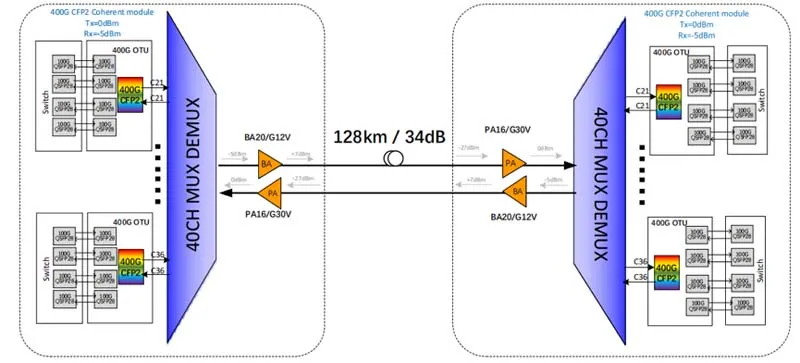
- Data Center Interconnect (DCI) Deployment
Data centers require fast, stable, and large-capacity interconnections. Therefore, the 400G DWDM coherent muxponder is widely used in DCI scenarios.
For example, modules such as 400G QSFP-DD ZR+ support 400 Gbps transmission over distances of up to 120 km. With this ability, data centers in different locations can share data, back up critical information, and build disaster-recovery links. Moreover, this solution helps maintain high bandwidth while improving operational continuity.
- Metropolitan Area Network (MAN) Transmission
In metropolitan area networks, operators must connect core nodes, aggregation nodes, and access layers across wide urban regions. The 400G DWDM coherent muxponder enables multiple 400G wavelengths to coexist on a single optical fiber.
This approach increases fiber efficiency and still maintains excellent performance.
Furthermore, the device provides stable high-capacity support for cloud services, enterprise connections, and public service networks within the city.
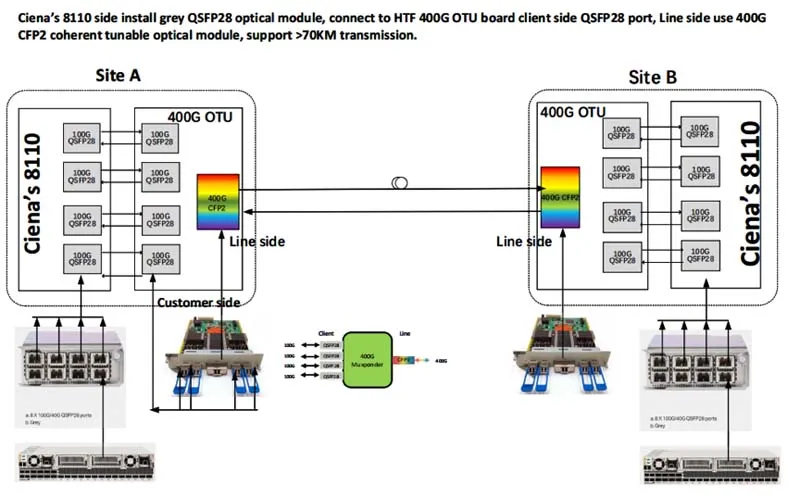
- Long-Haul and Regional Backhaul Networks
Another major application lies in long-haul and regional backhaul transmission.
Through advanced coherent detection, strong FEC coding, and optical amplification technology, the 400G DWDM coherent muxponder can achieve non-electrical-relay transmission of up to 200 km.
Because of this feature, it is ideal for inter-city and inter-regional links that demand both distance and capacity.
Additionally, it helps operators reduce relay station construction costs and simplifies network architecture.
- Multi-Service Integration for Complex Networks
Modern networks often need to integrate a wide range of services. The 400G DWDM coherent muxponder supports many client protocols, including:
- 10/25/100GbE
- 16G/32G FC
- OTU2/OTU2e/OTU4
Thanks to this compatibility, different-rate services can be aggregated into a single 400G coherent uplink.
As a result, enterprises and carriers can combine data, storage, cloud computing, and other services without redesigning the network.
This flexibility greatly improves efficiency and reduces deployment complexity.
- Easy and Scalable Network Capacity Expansion
The 400G DWDM coherent muxponder also offers significant advantages in future scalability.
Operators can expand their transmission capacity to 40 × 400G = 16T, which supports long-term network growth.
Moreover, this upgrade can be completed without major changes to existing fiber infrastructure.
Consequently, users can build a cost-effective and sustainable expansion strategy that adapts to rising traffic demands.
The 400G DWDM coherent muxponder plays a vital role across DCI connections, MAN transmission, long-haul backbone networks, and multi-service integration.
Its high bandwidth, long-distance performance, and flexible scalability make it a strong choice for network modernization.
If you need to upgrade your optical transmission system, you can contact the HTF DWDM team for further solutions.
