
100G QSFP28 ZR4 has become an increasingly important optical module as 100G Ethernet rapidly evolves into the mainstream standard for modern data center interconnection (DCI). As bandwidth demand continues to grow, operators are not only pursuing higher transmission rates but also seeking solutions that balance cost, power consumption, and deployment simplicity.
Therefore, choosing the right 100G optical module is critical. Among the available 80 km DCI solutions, 100G QSFP28 ZR4 stands out as a highly efficient and cost-optimized option.
Why 100G QSFP28 ZR4 Matters in 100G DCI Networks
As data centers expand across metropolitan areas, long-haul interconnection within 80 km becomes a common requirement. Traditionally, network designers relied on complex transmission architectures. However, 100G QSFP28 ZR4 simplifies this challenge by delivering native 100G Ethernet transmission over single-mode fiber without additional optical amplification or dispersion compensation.
Moreover, 100G QSFP28 ZR4 complies fully with IEEE 802.3 100GBASE-ZR4 specifications and the QSFP28 MSA standards defined in SFF-8665 and SFF-8636. As a result, it integrates seamlessly with switches, routers, and transport devices while providing reliable digital diagnostics through the I2C interface.
100G QSFP28 ZR4 Architecture Explained
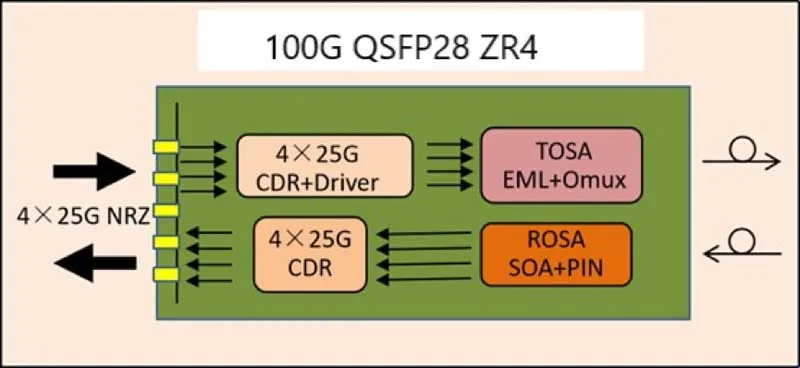
From a technical perspective, 100G QSFP28 ZR4 adopts a mature and proven CWDM-based architecture. On the transmitter side, four serial NRZ electrical signals are recovered by the CDR and drive four lasers operating at center wavelengths of approximately 1296 nm, 1300 nm, 1305 nm, and 1309 nm.
These optical signals are then multiplexed and transmitted over a single-mode fiber through a standard LC connector. On the receiver side, the process is reversed. First, the optical signals are amplified by a semiconductor optical amplifier (SOA). Next, an integrated optical demultiplexer separates the wavelengths. Finally, each channel is detected by a PIN photodiode and converted back into electrical signals through a TIA and CDR.
In addition, 100G QSFP28 ZR4 supports KR4 Forward Error Correction (FEC). Consequently, link stability improves, and transmission errors are effectively corrected at the receiver side.
Comparing 100G QSFP28 ZR4 with Other 80 km DCI Solutions
To better understand the value of 100G QSFP28 ZR4, it is helpful to compare it with alternative 100G long-haul solutions commonly used in metro and DCI environments.
100G Coherent Optical Modules
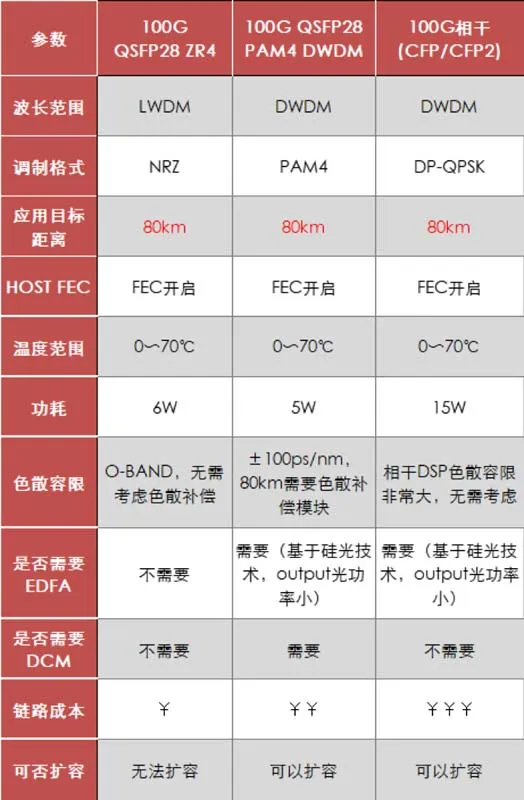
Traditionally, coherent modules in CFP or CFP2 form factors have been deployed for long-haul metro transmission. These solutions rely on advanced modulation schemes such as QPSK or QAM and require sophisticated DSP processing for dispersion compensation.
However, although coherent technology supports very long distances, it introduces higher costs, greater power consumption, and larger module sizes. As a result, deployment often requires dedicated line cards, which increases both capital and operational expenses.
100G PAM4 DWDM Solutions
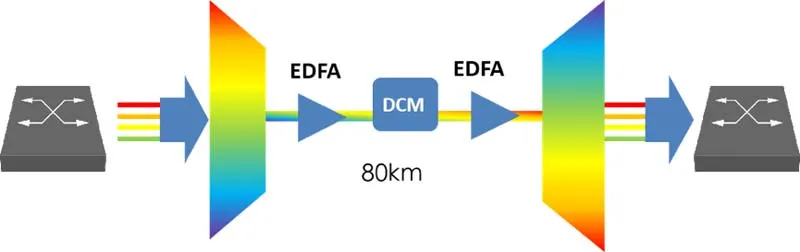
Meanwhile, 100G PAM4 DWDM has emerged as another alternative. While it offers high spectral efficiency, PAM4 modulation typically requires external amplification and dispersion compensation beyond short distances.
Therefore, when transmission exceeds several kilometers, operators must deploy additional equipment such as Mux/Demux, EDFA, and DCM. Consequently, overall network complexity and cost rise significantly, and compatibility with standard 50 GHz DWDM grids can become a limitation.
Why 100G QSFP28 ZR4 Is the Preferred Choice
In contrast, 100G QSFP28 ZR4 effectively overcomes the limitations of both coherent and PAM4 DWDM solutions. Because it is packaged in a compact QSFP28 form factor, it consumes less power and fits directly into standard Ethernet switch ports.
More importantly, 100G QSFP28 ZR4 supports point-to-point transmission up to 80 km without requiring optical amplification or dispersion compensation. As a result, network deployment becomes simpler, faster, and more cost-efficient.
Additionally, its true plug-and-play nature reduces operational complexity. Network operators can scale DCI links rapidly while maintaining predictable performance and reliability.

Conclusion: 100G QSFP28 ZR4 as the Smart DCI Investment
In summary, 100G QSFP28 ZR4 delivers a unique balance of performance, simplicity, and cost efficiency for 100G long-haul data center interconnection. Compared with coherent solutions, it offers lower power consumption and reduced hardware costs. Compared with PAM4 DWDM approaches, it eliminates the need for complex and expensive optical infrastructure.
Therefore, for 100G 80 km DCI applications, 100G QSFP28 ZR4 is widely recognized as the most practical and preferred solution for modern data center networks.